Multifamily EV Charging Retrofits: A Property Manager's Guide
The tenant demand is here. The state mandates are coming. Here's how to retrofit an existing multifamily property with EV charging infrastructure that protects the pavement, the chargers, and your operating budget.
The multifamily EV charging conversation used to be about future-proofing. It isn't anymore. Class A tenants in Seattle, Portland, and the Bay Area are choosing between buildings partly on EV charging capacity. Property managers who don't retrofit are losing lease-ups to buildings that have. Here's how to do the retrofit right, with real numbers on cost, timing, and how to fund it.
The regulatory backdrop
Four regulatory drivers are actively shaping multifamily EV charging in TimberShield's markets:
Washington HB 1544 (effective 2027). New multifamily construction over 25 units must include 20% EV-ready parking (conduit and panel capacity), 10% EV-installed (hardware in place). Retrofits triggered by "substantial alteration" per WAC. Timeline pressure: Q1 2027 for new starts.
California CALGreen T24 §4.106.4 (updated 2025). Existing requirement of 10% EV-ready expanded to 40% for new multifamily. Retrofits triggered by parking lot resurfacing over 5,000 sq ft. Every California multifamily property manager should assume they'll trigger this within 5 years.
Oregon Reach Codes. Adopted by Portland, Bend, Eugene, others. Multifamily EV-ready requirements at 30%. Extends to renovations affecting parking.
Federal Alternative Fuel Vehicle Refueling Property Credit (26 USC §30C). 30% federal tax credit on charging equipment and installation labor, capped at $100K per property. Extended through 2032. Multifamily properties in low-income or non-urban census tracts qualify at a higher rate.
The retrofit challenge
Retrofitting existing multifamily properties for EV charging is meaningfully harder than new construction. Three challenges dominate:
Electrical infrastructure. Most multifamily properties built before 2015 have service panels sized for original loads. Adding 4-8 Level 2 chargers can require a service upgrade. Utility timelines for service upgrades in the Western US currently run 4-14 months.
Pavement condition. Existing parking often has 15-25 years of asphalt fatigue. Installing chargers means trenching for conduit, which damages the pavement further. Ignoring this leads to $30-60K in follow-on repaving costs within 2-3 years.
Cost allocation. Who pays? The property owner is expected to install; the tenants use it; the utility bills someone. Most multifamily deployments end up with a hybrid model — property owner installs infrastructure, tenants pay per-session via metered charging.
Why timber canopies fit the retrofit
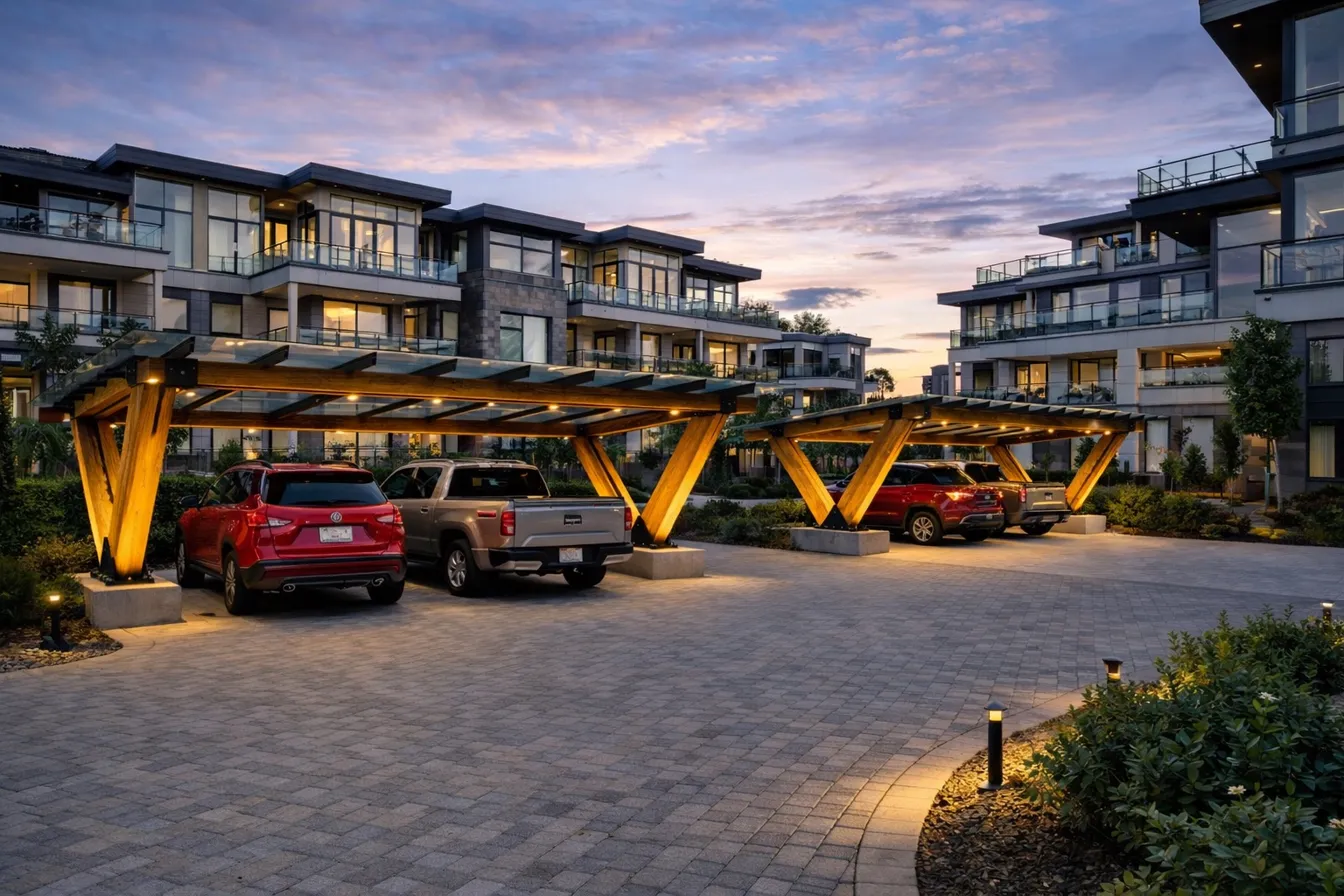
EV canopies with TimberShield's V-Leg system solve three retrofit problems simultaneously:
Pavement protection. Overhead cover extends the asphalt life of the parking below by 30-50% by shading it from UV and shielding it from rain. On a 20-year hold, avoided repaving typically pays for a significant portion of the canopy cost.
Charger longevity. Level 2 chargers exposed to weather have 60-70% of the design life of covered chargers. Manufacturer warranties are typically longer for covered installations. Uptime is measurably higher.
Tenant experience. The lease-up value of "covered EV charging" versus "exposed EV chargers in parking lot" is significant in Class A markets. Tenants notice, especially in PNW rain climates.
Permit-ready. Every TimberShield structure ships with stamped IBC drawings. Multifamily jurisdictions typically don't require additional structural review, which shaves 4-8 weeks off the retrofit timeline.
Cost breakdown per property
For a 4-charger retrofit at a 60-unit multifamily property (typical Class A Seattle):
- TimberShield TS-44 canopy with metal roof (installed): $42K
- Concrete foundation + prep: $8K
- Electrical service upgrade (if needed): $18-35K
- Conduit + panel work + chargers: $12K
- 4× Level 2 charger hardware: $8-14K
- Charger network activation + first-year service: $2-3K
- Permit fees: $1.5K
Total: $92-116K installed. Federal tax credit at 30% brings this to $64-81K net. Utility rebates in some jurisdictions bring it lower still.
Amortized over 20 years and offset by rental premiums (typical: $25-50/month per unit for buildings with covered EV charging as an amenity), retrofits typically show positive ROI within 4-7 years.
Timeline for a full retrofit
A well-managed multifamily EV retrofit follows this sequence:
- Weeks 1-2: Site survey, electrical assessment, tenant survey. Determine service upgrade requirement.
- Weeks 2-4: Utility service upgrade application if required. Design finalization. Charger network selection.
- Weeks 4-8: Building permit + electrical permit submission. HOA/tenant board approval in parallel.
- Weeks 8-16: Utility service work (if applicable — this is the longest lane). Concurrent: charger hardware procurement, finish material selection.
- Weeks 16-18: Foundation pour + cure.
- Weeks 18-20: Canopy install (typically 3-5 days on-site).
- Weeks 20-22: Charger installation, commissioning, network activation.
Total realistic timeline: 5-6 months. Buildings without a service upgrade requirement can compress this to 3-4 months.
Grants and incentives to stack
The economics get significantly better when you stack incentives properly:
Federal: 26 USC §30C (30% credit, $100K cap per property).
State (WA): Department of Commerce EV charging grants for multifamily; funding varies by legislative cycle.
State (CA): CALeVIP program for multifamily; up to $8K per charger.
State (OR): Oregon Clean Vehicle Rebate Program extended to some multifamily projects.
Utility: Puget Sound Energy, Seattle City Light, Portland General Electric, and PG&E all have multifamily EV programs offering $500-4K per port in rebates.
Property tax: Some jurisdictions exempt EV charging infrastructure from property tax assessment increases.
Stacking federal + state + utility incentives can offset 40-60% of retrofit cost on well-positioned properties.
Site survey checklist
Before scoping, gather:
- Total parking count and current utilization rate
- Existing electrical service size and available panel capacity
- Parking layout drawing (or clear photos)
- Age and condition of existing pavement
- Tenant survey results on EV interest (informal is fine)
- HOA covenant restrictions on parking modifications
- Utility account information (for rebate applications)
- Property tax assessor information (for exemption applications)
With these in hand, a scoping conversation with TimberShield typically produces a preliminary quote within 48 hours and a full stamped-drawing package within 2 weeks.
The strategic argument for retrofit now
Regulatory pressure is escalating, tenant expectations are shifting, and the federal 30% tax credit sunsets in 2032. Properties that retrofit in 2026-2028 lock in the incentive stack while benefiting from lease-up premium and pavement protection. Properties that wait will face higher installation costs, tighter utility service queues, and a smaller (or expired) federal credit.
For property managers scoping this: bring the site survey checklist to a 30-minute conversation. TimberShield's team has retrofitted multifamily properties across Washington and Oregon and knows the specific utility, incentive, and permit paths in each jurisdiction.
Have a project that fits this brief?
Send dimensions, site photos, and a one-line description. TimberShield handles design assist directly — quote turnaround is typically same-day.