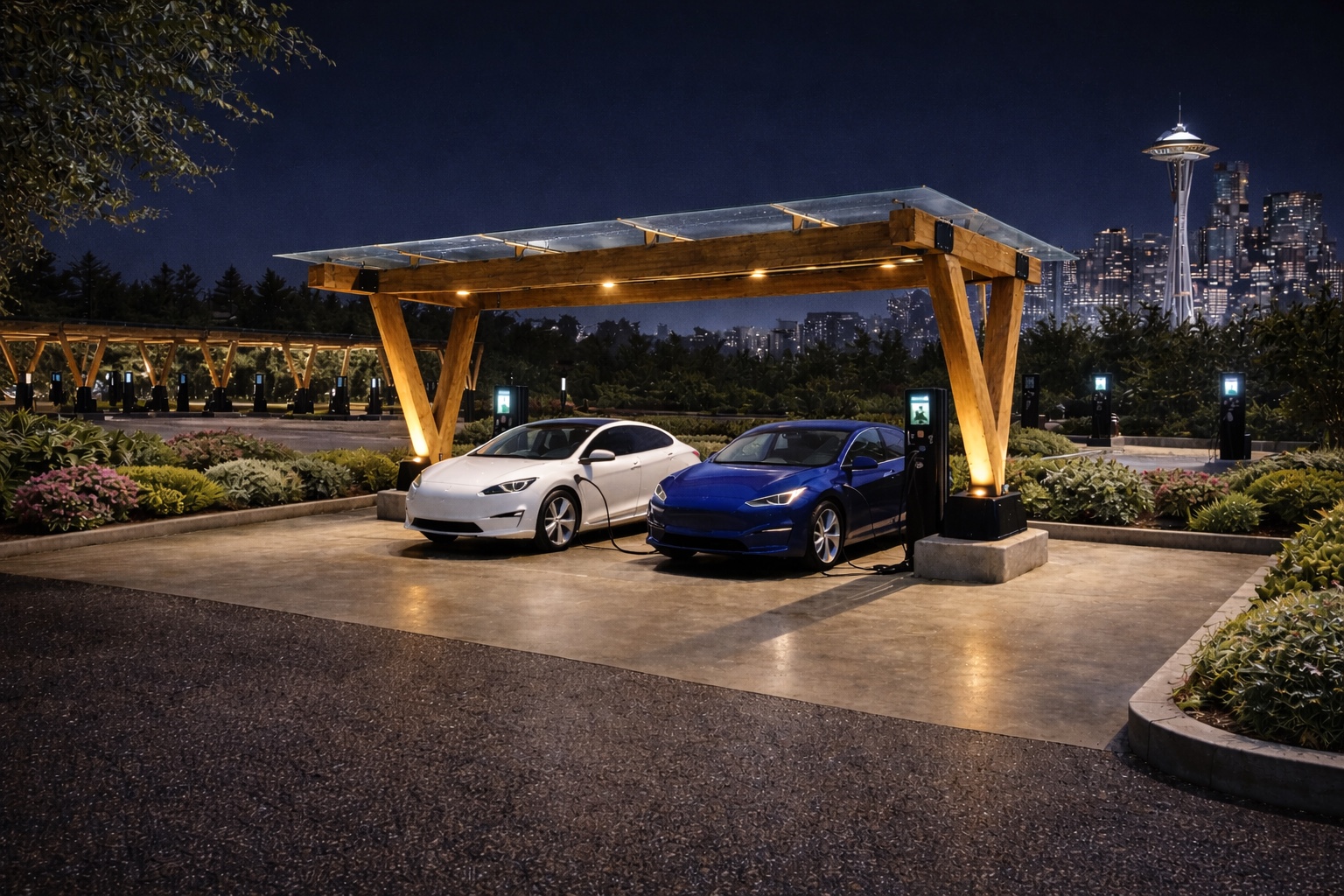
Engineering EV Canopies for the Pacific Northwest
Why Douglas Fir outperforms steel under PNW snow, wind, and chronic moisture — and what that means for charger uptime.
When we engineered the TimberShield V-Leg system, the brief was simple: a canopy that protects EV chargers in Pacific Northwest conditions for 40 to 60 years without structural intervention. Steel can't meet that brief. Here's why.
The PNW load profile
The Pacific Northwest is structurally hostile to thin-wall steel construction in ways most California-engineered canopy designs ignore. Three forces compound:
Snow loading. The IBC requires design for ground snow loads from ASCE 7 maps. Snoqualmie Pass sits at 89 lb/ft². Stevens Pass: 105 lb/ft². Even Seattle's relatively mild 25 lb/ft² compounds with drift loading against any canopy edge.
Wind loading. ASCE 7 Exposure C with PNW wind speed maps puts most projects at 110-120 mph design wind. That's uplift forces of 30-45 lb/ft² on a canopy roof — pulling, not pushing.
Chronic moisture. Average RH above 75% from October through May. Persistent wetting at every fastener penetration, every panel seam, every welded joint.
Why steel fails the brief
Steel canopies don't fail in dramatic ways. They fail in maintenance accumulation. Three failure modes dominate field reports from EV charging operators:
Galvanic corrosion at panel-to-fastener interfaces. Mixed metals (steel structure + aluminum panels + zinc-coated fasteners) create electrochemical cells in chronic wet conditions. Visible rust at 8-12 years.
Thermal bridging causes condensation. Steel conducts. Interior surfaces of steel members drop below dew point on cold nights. Water beads, drips onto chargers below. We've seen multiple deployments where condensation drip caused service calls on otherwise healthy charging hardware.
Welded joint fatigue under cyclic snow loading. Snow loads aren't constant — they cycle daily as temperatures fluctuate. After ~5,000 load cycles (roughly 15 years in PNW conditions), weld toes initiate fatigue cracks. Repairs require complete charger shutdown.
The Douglas Fir solution
Pacific Northwest old-growth Douglas Fir evolved in these conditions. The engineering properties are exactly what the load profile demands:
Specific gravity 0.48, allowable bending stress (Fb) of 1,000 psi minimum for #1 Dense. Pound-for-pound, structural Doug Fir delivers comparable bending capacity to mild steel at 20% of the weight. That weight reduction means smaller foundations, lower seismic mass, and lower install crane time.
Hygroscopic equilibrium. Wood reaches moisture equilibrium with ambient air and stays there. It doesn't rust, doesn't corrode, doesn't conduct condensation. A properly-detailed Doug Fir canopy in PNW conditions has a documented service life of 40-60 years with no structural maintenance.
Compression-friendly under snow. Wood's anisotropic structure handles compression loading along the grain extremely well. The TimberShield V-Leg geometry channels snow load directly into axial compression in the two 10×14 Doug Fir timbers — exactly the load case wood handles best.
The V-Leg geometry, briefly
Two 10×14 structural Douglas Fir legs, each set at 20° from vertical (40° included V-angle), meeting at a steel base plate anchored to a 4'×4'×3' reinforced concrete footing. IBC engineered, permit-ready. The 20° per-leg angle isn't arbitrary — it's the load-path optimization that puts snow load into compression while reducing lateral wind moment by 60% versus a vertical post.
Charger compatibility
The TS-12 (single-bay, 12 ft × 24 ft) handles every Level 2 and most DC fast chargers on the market: Tesla Supercharger V3 and V4, Tesla Wall Connector, ChargePoint Express 250, Electrify America 350kW, EVgo, Blink, Wallbox. Bay spacing accommodates standard 9 ft parking widths plus the 18-inch charger clearance most utilities require.
For commercial deployments, the TS-44 (4-bay, 44 ft × 24 ft) and TS-64 (6-bay, 64 ft × 24 ft) scale linearly with no engineering re-work — the V-Leg modules are identical, just repeated. EX-20 extension modules add bays in 20 ft increments after the initial install.
What it costs vs steel
At first quote, Doug Fir runs 10-15% above comparable steel. That delta closes within 8 years on a Net Present Value basis once you factor in:
- Zero structural maintenance for 40-60 years (steel: $2-4K every 7-10 years for galvanizing repair, rust remediation)
- No charger downtime from condensation service calls
- No weld inspection cycles
- Insurance premium reduction (timber is Type V construction; many carriers price it 8-12% under steel for canopy structures)
Most operators we work with see total cost of ownership equivalence around year 8 and savings of 30-40% over the 40-year canopy lifespan.
The honest tradeoffs
Doug Fir isn't a fit for every site. Three cases where steel is genuinely the better choice:
- Sites with extreme fire risk (WUI zones). Doug Fir is Type V combustible construction. WUI ordinances increasingly require Type I/II non-combustible. Steel wins.
- Sites with span requirements over 28 ft. Wood capacity drops nonlinearly. Steel can span 40-50 ft on a single bay; wood needs intermediate supports.
- Sites with no architectural priority. If the canopy is purely functional and the operator doesn't care about appearance, the 10-15% premium for Doug Fir is hard to justify on aesthetics alone. Steel works fine in those cases.
Outside those cases — and the Pacific Northwest is overwhelmingly outside those cases — Douglas Fir is the engineered answer.
Have a project that fits this brief?
Send dimensions, site photos, and a one-line description. TimberShield handles design assist directly — quote turnaround is typically same-day.