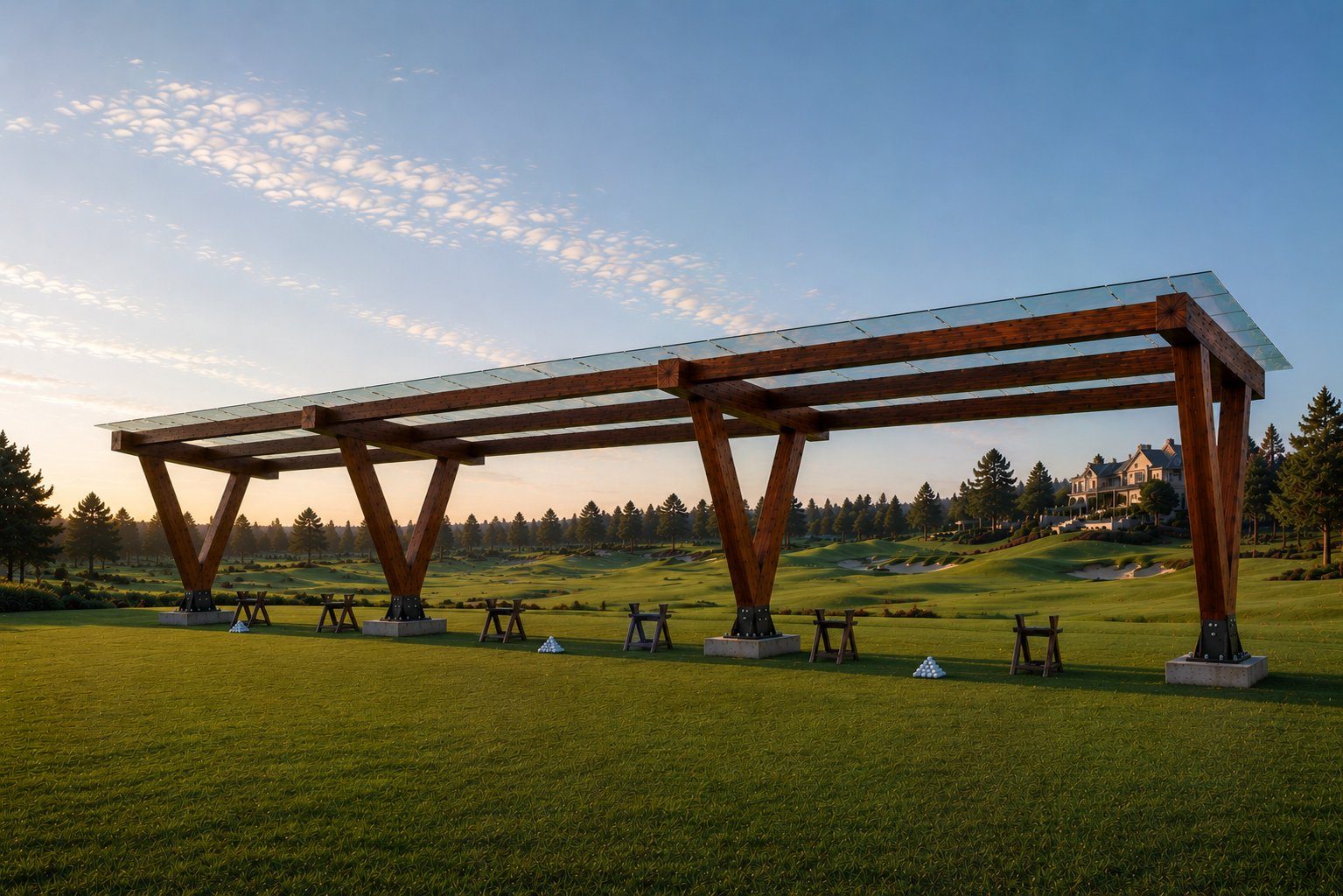
Architectural Fabric Canopies for Golf
Year-round practice cover with course branding built into the membrane — at no added cost over a base canopy.
For a 30-bay driving range in the Pacific Northwest, weather-driven closure costs are real. A range at $8/bucket × 45 buckets/day/bay × 100 lost days = $1.08M in deferred revenue annually. The math on year-round protection is hard to ignore — and the fabric roof option is what makes the math work.
Why a fabric roof instead of metal or glass
TimberShield V-Leg canopies ship with three roof options. For golf, fabric is almost always the right choice:
Light transmission. PVDF/PVC architectural membrane transmits 12-15% of visible light — enough to feel open and bright underneath, but with full UV-blocking. Players don't squint, don't lose ball flight against a dark background, and don't bake in summer heat.
Acoustic damping. Fabric absorbs sound. Metal roofs amplify it. With 30 players hitting at once, the acoustic difference between fabric and metal is dramatic — fabric reads as quiet practice, metal as a rifle range. This matters more than operators expect until they hear both.
Custom branding included. This is the differentiator. Dye-sublimation or UV-print onto the PVDF membrane is included at no extra cost on every fabric canopy order. Course logos, sponsor banners, team colors, hole graphics — printed directly into the roof. The branding becomes architectural, not signage.
How fabric branding works, technically
Two print methods, depending on graphic complexity:
Dye-sublimation for full-color photographic graphics. Inks gas-phase into the PVDF coating, becoming part of the membrane rather than a surface coating. Design life: 12-15 years before measurable fade.
UV-cure printing for solid colors and crisp logos. Inks cured by UV light onto the surface. Easier to update (you can re-skin the membrane in 7-10 years and reprint with current branding), slightly less photographic fidelity. Design life: 8-10 years.
Most courses choose dye-sublimation for the underside (visible to players) and leave the topside white or a course-color solid. The membrane is two-sided — different graphics topside and bottomside is standard, no premium.
The membrane itself
Commercial PVDF (polyvinylidene fluoride) over a PVC base layer. Same membrane material as stadium roofs (Allianz Arena, Beijing Water Cube). Tensile strength 600 lb/in warp, 550 lb/in fill. Translucency 12-15%, opacity tunable via membrane spec. Design life 15-20 years before re-skinning.
Maintenance: rinse with water annually. PVDF is self-cleaning under rainfall — the same property that makes Teflon coatings non-stick prevents grime adhesion. No painting, sealing, or coating refresh.
Sizing for golf
The TS-44 (4-bay, 44 ft × 24 ft) is the sweet spot for most ranges. Covers four standard 11 ft hitting bays with 18 inches of clearance on each side. Roof clearance at 12 ft from the hitting surface, which handles 100% of realistic swing arcs including driver overswings.
For larger ranges, scale with EX-20 extension modules in 20 ft increments. A 12-bay TS-44 + 4× EX-20 setup covers 124 linear feet — enough for 12 bays with no support post in any hitting line.
Fabric upgrade pricing
Above base canopy price (metal roof is the base):
- TS-12: +$3,000
- TS-24: +$4,500
- TS-44: +$9,000 ← sweet spot for golf
- TS-64: +$13,500
- EX-20 extension: +$4,500 per module
Custom branding is included in the upgrade price. No separate print fees, no setup charges, no minimum graphic complexity. Course logos through full-photographic graphics are all at the same price.
Real-world ROI
A 12-bay TS-44 + 2× EX-20 setup at a 100-bay range example (PNW):
- Canopy + fabric upgrade installed: ~$220K
- Recovered revenue from 80 weather-lost days: ~$350K/year
- Payback: under 8 months
- Sponsorship revenue from branded canopy (typical: $15-30K/year for a regional sponsor): bonus margin
This isn't a hypothetical. Three of our golf clients had positive ROI within their first full season.
Beyond the driving range
Two other golf applications where fabric canopies make sense:
Cart staging and bag drops. TS-24 over the cart staging area protects carts and electronics from rain damage. Course logo on the underside becomes the first thing players see as they pull up. Many clubhouse architects miss this opportunity.
Member events and tournament hosting. A TS-44 or larger near the practice green or 18th green creates a covered hospitality zone for tournaments. Fabric branding rotates per event (membrane swap takes ~4 hours with a crew).
If you're sizing a project, the fastest path is a 15-minute call with TimberShield — he'll run dimensions and bay counts against your range layout and quote within the day.
Have a project that fits this brief?
Send dimensions, site photos, and a one-line description. TimberShield handles design assist directly — quote turnaround is typically same-day.