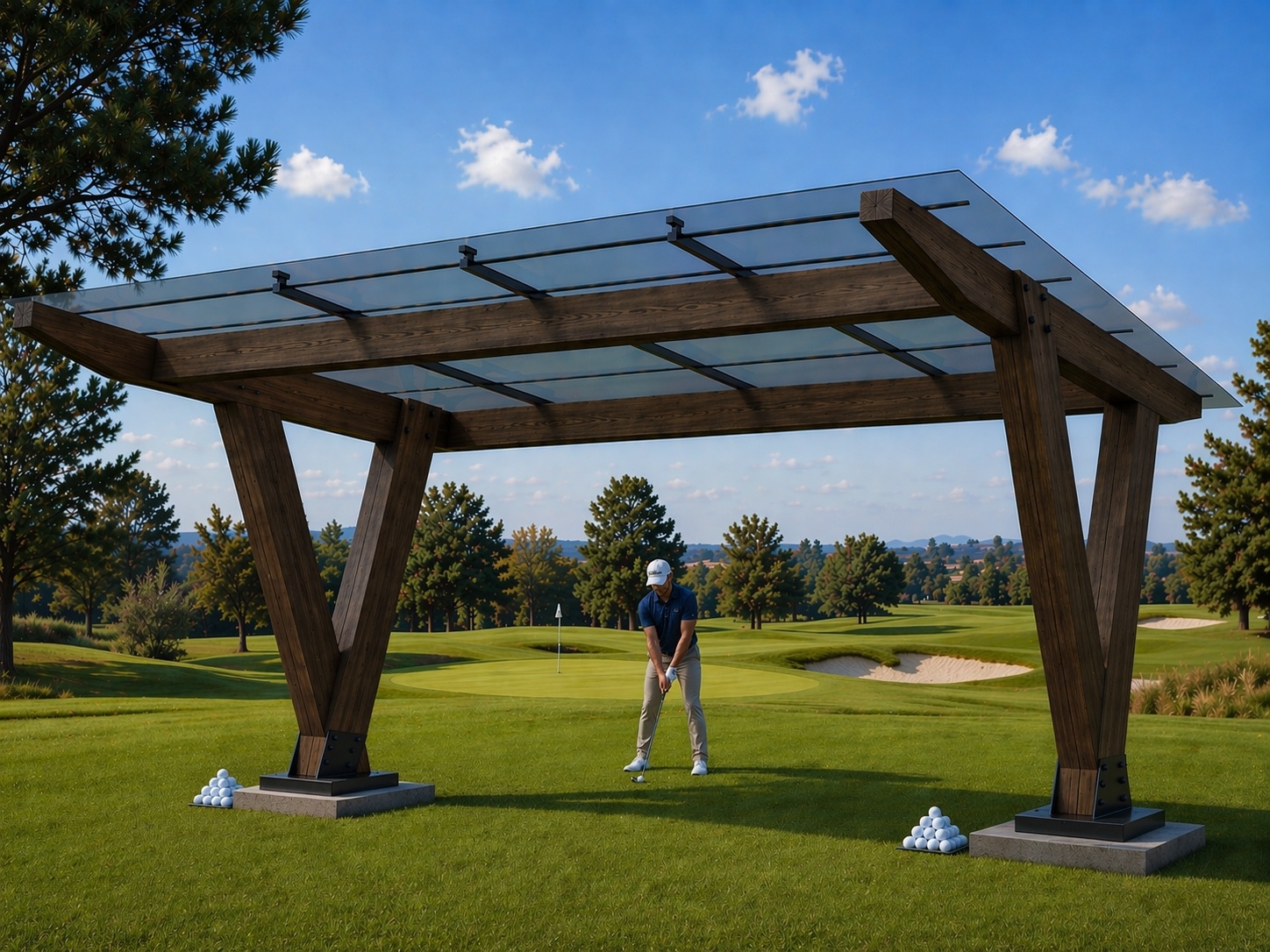
The driving range cover that looks like the clubhouse.
TimberShield is the only US-built heavy timber driving range cover engineered for permanent installation. Every visible US competitor — DryRainge, RangeBay, MovCov, ForeBay — ships a fabric or galvanized steel solution designed for seasonal coverage and 5-to-8-year service life. TimberShield is the country-club tier: 10×14 Douglas Fir, IBC-engineered, 40 to 60 year design lifespan, and an optional tinted laminated tempered glass roof that turns the range into a daylight-lit architectural feature.
Built originally for Pacific Northwest private clubs that wanted year-round practice without a metal pole shed bolted to the corner of the property, the V-leg system has expanded to municipal courses, PGA teaching academies, residential simulator setups, and dedicated Toptracer Performance Centers. The architecture sits comfortably next to a clubhouse or stone-and-cedar pro shop — and ages with the property rather than against it.
The Toptracer Performance Center trend has reshaped what a driving range can be. Heated bays, food and drink service, dimmable architectural lighting, and year-round usage are now the bar. Heavy timber is the structural envelope that signals the upgrade — and that members talk about.
Get a Custom Quote →Covered practice is the operations decision that pays for itself.
The math on a covered driving range is consistent across regions and club tiers. Member usage rises, lesson cancellations drop, range revenue smooths through bad-weather months, and the practice facility becomes a year-round amenity rather than a fair-weather one. The Golf Range Association has tracked the trend for years — Toptracer Performance Centers, heated and covered hitting bays, food-and-drink service zones have moved from novelty to expectation at competitive clubs.
What heavy timber adds on top of that is brand differentiation. A range cover built in fabric and galvanized steel works. A range cover built in 10×14 Douglas Fir with a tinted laminated tempered glass roof shows up in member-facing photography, on social media, in the prospect tour for new memberships. It changes how the facility is perceived — not just how often it's used.
"We installed a TS-44 over our driving range last spring. Member usage is up 40% year-over-year and we've had zero weather cancellations since. Best facility investment we've made in a decade.
Five facility tiers, one structural system.
Country clubs & member-only practice facilities
The tier where architectural quality matters as much as structural performance. A TS-44 or TS-64 driving range cover gives members a year-round practice amenity that matches the clubhouse and pro shop in materials and detailing.
Public golf courses & learning centers
Smoother revenue through wet months, higher facility utilization, and a covered practice option that doesn't look like a temporary fabric shelter. Permit-ready engineering keeps the procurement process clean.
Teaching academies & performance centers
Toptracer Performance Centers, Trackman teaching studios, FlightScope-equipped bays. Pre-engineered ceiling mounting points and integrated lighting designed into the structure — no retrofit improvisation.
Backyard practice areas & home simulators
Single-bay TS-12 structures for dedicated practice tees and simulator enclosures. The same V-leg architecture that scales to a 64-foot range cover anchors a single residential teaching bay. See residential applications →
Stand-alone commercial ranges
Multi-bay TS-44 or TS-64 with EX-20 extensions for full coverage. Premium positioning differentiates from regional competitors using fabric shelters. The architecture supports food, drink, and entertainment-tier offerings on top of practice.
Heavy timber vs. fabric vs. steel vs. pergola.
Four real options for covered golf practice — each at a different tier of permanence, architecture, and lifespan. Heavy timber occupies the country-club category that none of the others target.
| Feature | TimberShield Heavy Timber | Fabric Range Shelter | Galvanized Steel | Wood Pergola |
|---|---|---|---|---|
| Design lifespan | 40–60 years | 5–8 years (fabric) | 10–15 years | 10–20 years |
| Architectural quality | Country-club tier | Utility | Utility | Casual residential |
| IBC engineered | Yes — stamped | Limited | Varies | No (typically) |
| Wind & snow rated | 120–150 MPH / 25–80 PSF | Light loads only | Moderate | Not rated |
| Glass roof option | Tinted laminated tempered | No | No | No |
| Toptracer-ready | Designed-in mounts | Field retrofit | Field retrofit | Field retrofit |
| Member-visible quality | Photographed & posted | Tolerated | Ignored | Backyard feel |
| Permit ease | Stamped drawings included | Often unpermitted | Varies | Limited |
| Maintenance cycle | Recoat 2–4 yrs | Replace fabric every 5–8 yrs | Repaint 5–7 yrs | Refinish 2–3 yrs |
Geometry designed for the swing path.
Most range cover failures come down to one of three things: not enough clearance for full driver swings, center posts in the line of sight or swing path, or roof systems that flutter and distract in wind. The V-leg geometry was engineered around all three.
- 13'6" front eave, 9'0" rear eave. 2:12 pitch from rear to front means the high point of the canopy is well above any driver's apex — and the roof drains away from the hitting line.
- Zero center posts. The V-leg supports two bays per leg with the cap beam spanning between V-legs. There are no obstructions in any sight line or swing path within the bay.
- Rigid 10×14 Douglas Fir. No fabric flutter, no oscillation in wind. The structure stays still while the golfer swings.
- Optional tinted glass roof. Daylight without UV exposure, no harsh shadows, no overhead glare on launch monitor screens. Members hit in natural light, year-round.
- Toptracer & Trackman ready. Cap beam mounting points are pre-engineered for overhead launch monitor cameras and projector systems.
Sized for every range and teaching facility.
Five configurations cover the full range from a residential simulator enclosure to a six-bay PGA teaching facility. Larger driving ranges chain TS-64 and EX-20 to scale into 84-foot, 104-foot, or unlimited configurations.
Every model includes the 24-gauge Commercial Metal Roof metal roof. Upgrade to tinted structural laminated tempered glass, integrated dimmable LED lighting, gutters, and Toptracer / Trackman mounting hardware — all quoted on the site-specific proposal.
Built to commercial code — engineered for the swing.
Structural & Clearance
- 10×14 Douglas Fir V-legs and cap beam
- 40° V-angle (20° per leg), 2:12 cap beam pitch
- 13'6" front eave, 9'0" rear eave
- Zero center posts within any bay
- 120–150 MPH wind, 25–80 PSF snow load rated
Roof Options
- Standard: 24-gauge Commercial Metal Roof metal
- Upgrade: tinted structural laminated tempered glass
- Glass tints: Clear, Light Grey, Dark Grey
- Gutter and downspout systems available
- Solar racking compatible (metal roof)
Technology Integration
- Cap beam mounting for Toptracer ceiling cameras
- Trackman / FlightScope / Foresight launch monitor mounting
- Dimmable LED soffit lighting zones
- Ball tray shelving, ball tracker mounts, net systems available
- Conduit routing for power and data designed in
Installation & Permitting
- 2–3 days on-site for TS-12 / TS-24
- 3–5 days for TS-44 / TS-64
- Stamped IBC engineering drawings included
- Permits as accessory structure in most jurisdictions
- WEBS registered for Washington State procurement
"The V-leg design is unlike anything else on the market. It doesn't look like a cover — it looks like architecture. Our members comment on it constantly. TimberShield's team was professional start to finish.
Questions TimberShield gets from golf operators.
Is there enough clearance for a full driver swing under a TimberShield canopy?
Yes. The TimberShield front eave height is 13 feet 6 inches and the rear eave is 9 feet. The V-leg geometry pitches the roof from rear to front at 2:12, so the cap beam is well above the apex of any normal driver swing. PGA teaching professionals and country club ranges have used the same geometry since launch.
Will the canopy withstand a mishit or shanked golf ball strike?
10×14 Douglas Fir timbers and a 24-gauge Commercial Metal Roof metal roof are dramatically stronger than the loads a golf ball can deliver. Mishits at high range speed produce no visible mark on either the timber or the metal roof. For tinted laminated tempered glass roofs, the laminated safety glass is designed to withstand significantly higher impact loads than a stray ball.
Can the canopy be configured for Toptracer or other launch monitor systems?
Yes. The cap beam includes optional integrated mounting points for Toptracer ceiling-mounted cameras, Trackman launch monitors, FlightScope units, and similar overhead launch-monitor hardware. We coordinate with your technology installer during the engineering phase so mounting points, conduit, and power runs are designed in — not retrofit.
How does heavy timber compare to fabric range shelters like DryRainge or RangeBay?
Fabric range shelters are designed as economical seasonal coverage with 5 to 8 year fabric lifespans and noticeable wind movement. Heavy timber canopies are designed as permanent architecture with 40 to 60 year structural lifespans, IBC-stamped engineering, no fabric flutter, and the option of a tinted laminated tempered glass roof. Both have their place — when a club wants its range cover to look like part of the course architecture and last as long as the clubhouse, heavy timber is the right choice.
Can the canopy be lit for night practice and lessons?
Yes. Integrated LED soffit lighting is one of the most-requested upgrades. We design lighting zones into the cap beam during engineering — typically dimmable, color-temperature-tunable, motion-sensor optional. Combined with the warm Douglas Fir interior, the result is a practice environment that members actually choose over the open range at twilight.
What lead time should we plan on from contract to first golfer hitting?
Plan 8 to 14 weeks from signed contract to first ball struck under the canopy. That includes engineering and permit submittal (3 to 5 weeks), fabrication and finishing in the shop (3 to 5 weeks), site prep and footing cure (1 to 2 weeks), and on-site install (3 to 5 days for TS-44 and larger). We schedule fabrication and footing work in parallel where the AHJ allows it.
Can a TimberShield golf canopy be permitted as an accessory structure to our existing range?
In most municipalities, yes — the canopy is treated as an accessory structure to the existing golf use. We provide stamped IBC engineering drawings, structural calculations, and the site plan exhibits the AHJ typically requires. Several of our installs have permitted through standard accessory-structure review without requiring a full conditional-use process.
Cover your range. Keep members hitting year-round.
Send TimberShield your range layout, bay count, and target opening date. Site-specific itemized quote within one business day — structure, roof option, technology integration, footings, delivery, and install.