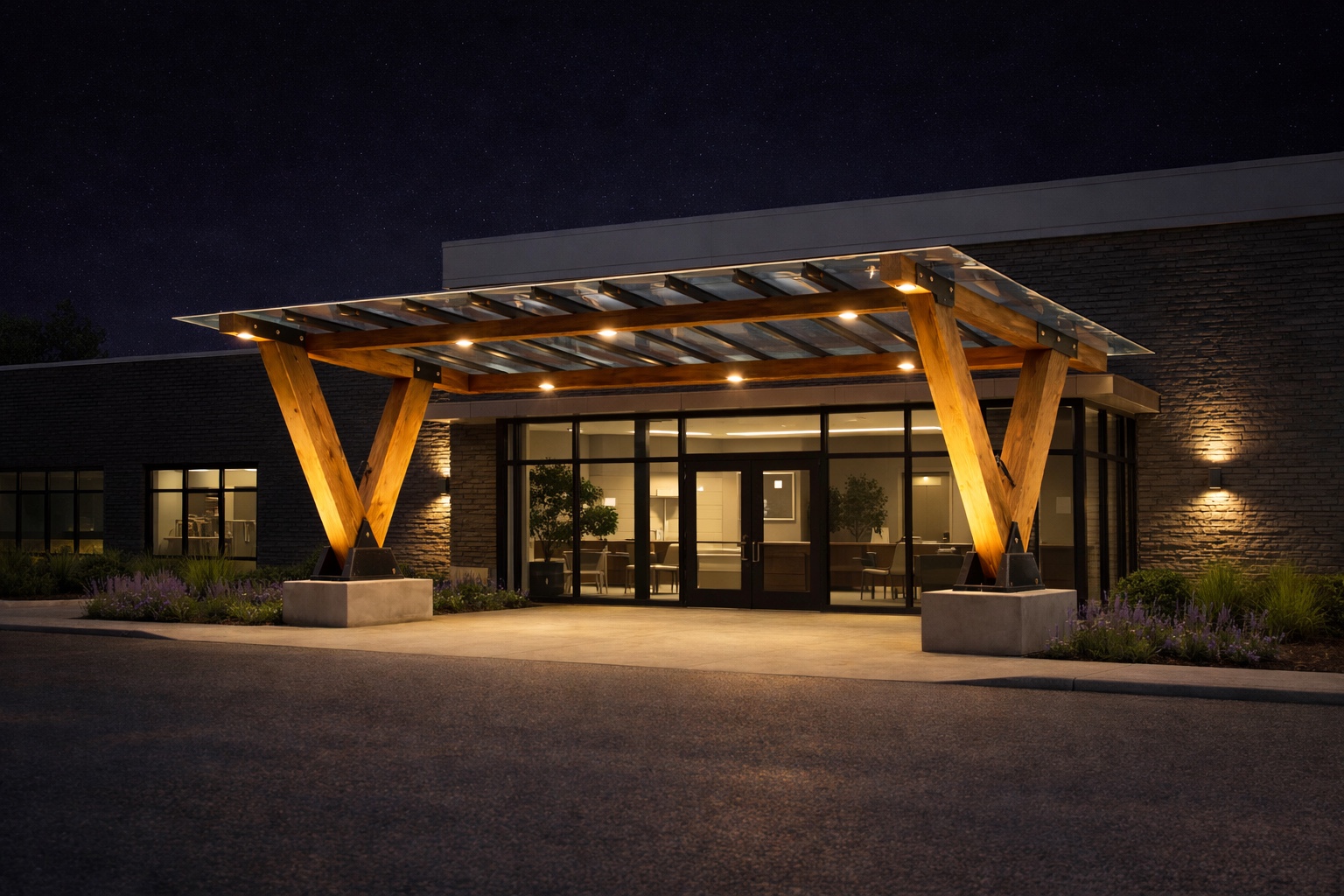
Heavy timber porte-cochères and commercial canopies.
TimberShield builds heavy timber porte-cochères, restaurant patio covers, hotel entrance canopies, hospital arrival canopies, office building entries, university plaza canopies, and architectural commercial structures across the Western US. Where the modern porte-cochère is dominated by metal canopies — generic across every hotel brand and aging visibly within 15 years — heavy timber is the differentiated architectural envelope for commercial brands that want their entrance to read as a signature, not a default.
Hospitality brands with farm-to-table, sustainable, mountain-resort, Pacific Northwest, or boutique-luxury positioning use heavy timber porte-cochères precisely because the material aligns with the brand. The same logic applies to restaurants whose patios are revenue centers, hospitals where the arrival experience matters to patient experience scores, universities where campus architectural vocabularies favor warmer materials, and religious facilities whose entries deserve craft rather than utility.
The ROI math on commercial canopies is unusually clean. Covered outdoor space adds revenue-generating square footage to restaurants and event venues. Premium porte-cochères increase perceived hotel quality (and review scores). Branded commercial canopies pay for themselves in operational lift and patron retention — often within the first season or two of operation.
Get a Commercial Quote →One restaurant, one canopy, 60% revenue lift.
Carlos V. runs a waterfront restaurant in Seattle. Before installing a TimberShield TS-24, his patio could seat 20 guests during good weather and sat empty most of the rest of the year. Pacific Northwest rain, wind, and cold meant the patio was a seasonal asset at best.
He added the TS-24 in spring. By the end of the first summer, covered seating capacity had more than doubled — to 48 chairs — and patio revenue was up 60% year-over-year. The structure paid for itself entirely within one season.
What the math doesn't capture: the patio is now a year-round destination, the heavy timber matches the waterfront architecture of the neighborhood, and customers photograph the patio for social posts that drive incremental walk-in traffic. The canopy stopped being a weather shelter and became part of the restaurant's brand identity.
The same operational lift applies to restaurants, hotels, hospitality venues, and event spaces across the Western US — anywhere covered outdoor space is revenue-generating.
"We added a TS-24 to our restaurant patio and covered seating went from 20 to 48 chairs. Revenue from the patio is up 60% since last year. It paid for itself in one summer season.
Eight contexts where heavy timber pays back.
Hotel porte-cochères & arrival canopies
The first impression of the property. Heavy timber porte-cochères signal boutique, premium, sustainable, or destination positioning in ways metal canopies cannot. Particularly suited to mountain resorts, coastal hotels, Pacific Northwest properties, and farm-to-table-positioned hospitality brands.
Patio covers & outdoor dining
Carlos V.'s 60% revenue lift is the case study. Covered patios more than double seating capacity, extend the operating season, and become photographable brand features. ROI typically returns within one to two operating seasons.
Corporate & tech campus entries
Signature heavy timber entrances for office buildings, tech campuses, and corporate HQs. Particularly resonant for organizations whose brand positioning favors warmth, sustainability, and craft over corporate-glass-tower aesthetics.
Hospital & clinic entrances
Hospital arrival experiences impact patient satisfaction scores. Heavy timber arrival canopies deliver weather protection for ambulance bays, ADA-accessible drop-off, and main entrances while signaling a hospitality-grade arrival experience rather than an institutional one.
Campus entries & plaza canopies
Library entrances, student union arrivals, residence hall plaza canopies, and event venue covered approaches. Heavy timber matches campus architectural vocabularies in ways prefab metal cannot — particularly at universities with cedar, brick, and timber-frame traditions.
Church & worship facility entries
Sanctuary entrance canopies, fellowship hall entries, and parking-to-doors covered walkways. The timber aesthetic aligns with the gravity and craft expected at houses of worship in ways that aluminum awnings do not.
Lifestyle centers & retail entries
Anchor-store entrances, lifestyle center plaza canopies, retail patio covers. Brand-aligned architectural quality that supports tenant differentiation and elevates the overall property experience above the metal-canopy default.
Auto dealerships & porte-cochères
Luxury and premium auto dealerships deploy heavy timber porte-cochères, service drive canopies, and EV-ready customer canopies as part of OEM-driven architectural upgrades. See the dealership canopy vertical for the full application breakdown.
The brand decision behind the structural one.
Commercial canopy procurement usually starts with structural and code requirements — wind load, snow load, ADA clearance, fire rating, lifecycle cost. Heavy timber clears all of those. The harder question is the brand one: what does the entrance say about the property?
- Differentiated brand expression. Most American commercial properties default to metal canopies and read identically. Heavy timber says something different — craft, permanence, sustainability, regional character.
- Brand-aligned material. Pacific Northwest, mountain resort, farm-to-table, boutique-luxury, sustainable-positioning brands have an existing material vocabulary that includes heavy timber. Metal canopies fight that vocabulary; Douglas Fir reinforces it.
- Photographable. Heavy timber canopies show up in guest social media, professional brand photography, real estate listings, and review platform photos. Metal canopies don't.
- Aging gracefully. Douglas Fir patinas over decades and looks better at year 20 than at year 1. Painted metal looks worse at year 10 than at year 1. Brand assets that improve with age are rare.
- Custom finish to brand. Stain selection, integrated signage mounting, dimmable LED zones, and finish detailing can be specified to brand standards in ways that prefab metal canopies cannot accommodate.
Sized to the commercial envelope.
Four configurations cover the full range from a single-bay restaurant patio extension to a six-bay hotel porte-cochère. Custom multi-bay dimensions are built by chaining base structures with EX-20 extensions to match site-specific architectural envelopes.
Every commercial model includes the 24-gauge Commercial Metal Roof metal roof. Hospitality and restaurant upgrades available: tinted laminated tempered glass roof, integrated radiant or infrared heating, dimmable LED soffit lighting with color-temperature tuning, brand signage mounting hardware, custom stain finishes, and gutter and downspout systems — all quoted on the site-specific proposal.
Built to commercial standards — finished to brand.
Commercial Code
- IBC engineered for commercial occupancy
- 120–150 MPH wind, 25–80 PSF snow load
- Fire rating per local AHJ requirements
- ADA-compliant clearances for commercial entry
- Stamped engineering documentation included
Hospitality Upgrades
- Integrated overhead radiant heating
- Infrared heating for restaurant patios
- Dimmable LED soffit lighting with zones
- Color-temperature-tunable lighting for evening service
- Motion sensor and dusk-to-dawn controls
Brand Customization
- Custom stain colors to brand palette
- Illuminated brand signage mounting
- Channel-letter and blade-sign hardware
- Custom dimensions via EX-20 extensions
- Architectural integration with existing facade
Operational Durability
- 40–60 year design lifespan
- 2–4 year recoat cycle (pressure wash + one-day finish)
- Built for high public traffic without wear
- Glass roof option for full daylight
- Vandal-resistant Douglas Fir finish
Questions TimberShield gets from commercial operators.
Will a heavy timber porte-cochère meet commercial building code?
Yes. Every TimberShield commercial canopy is IBC-engineered with stamped structural calculations, fire ratings, wind and snow load specifications, and ADA-compliant clearances. We coordinate directly with your architect, general contractor, or AHJ to confirm the configuration meets occupancy classification and commercial code requirements for the project.
How does heavy timber compare to metal porte-cochères for hospitality brands?
Metal porte-cochères dominate American commercial construction because they deploy fast and cheap — they also age visibly within 10 to 15 years and read as generic across every hotel brand using them. Heavy timber porte-cochères read as signature architecture. Boutique hotels, farm-to-table restaurants, mountain resorts, and hospitality brands with sustainable positioning use heavy timber precisely because it differentiates from the metal canopy default and aligns with brand-driven design intent.
Can the canopy be branded with our logo or custom signage?
Yes. We engineer signage mounting points into the cap beam during design — illuminated brand signage, blade signs, channel-letter wall signs mounted to the timber face, and projecting signage all work. Custom stain colors can be specified to match a brand's color palette, though most commercial clients stay with natural Douglas Fir tones that complement rather than compete with the brand's primary signage.
What is the maintenance cycle for a restaurant patio canopy?
Properly finished Douglas Fir requires a penetrating oil recoat every 2 to 4 years depending on sun and rain exposure. Unlike paint, the oil soaks in and never peels — a pressure wash and one-day recoat is all it takes. For high-volume restaurant patios with grease and food exposure, we recommend the upper end of the recoat frequency. This is significantly less maintenance burden than awning replacement or fabric structure repair cycles.
How does the canopy hold up to high public traffic?
10×14 Douglas Fir timbers and a 24-gauge Commercial Metal Roof metal roof are dramatically over-built for human-scale impact loads. Restaurant patios, hotel entrances, hospital portes, and university entries see thousands of arrivals per week and the structure shows no signs of wear that would be visible to a guest. Carlos V. installed a TS-24 over his Seattle restaurant patio and reports zero structural maintenance after sustained heavy use.
Can we add heating, lighting, and dimming for evening service?
Yes. Integrated heaters (overhead radiant or infrared), dimmable LED soffit lighting with color-temperature tuning, motion sensors, and zone-controlled lighting are all standard upgrade options. For restaurant patios specifically, the warm Douglas Fir interior combined with dimmable lighting creates an evening environment that drives turnover and patio revenue. We coordinate electrical and dimming hardware with your contractor during the engineering phase.
What lead time should we plan from contract to grand opening?
Plan 8 to 14 weeks from signed contract to first guest arrival under the canopy. That includes engineering and commercial permitting (3 to 5 weeks), fabrication and finishing (3 to 5 weeks), site preparation and footing cure (1 to 2 weeks), and on-site install (2 to 5 days depending on configuration). For grand opening or seasonal launch deadlines, we work backward from the opening date and confirm timelines against your construction schedule before contract.
Make your entrance part of the brand.
Send TimberShield your project type, target dimensions, brand context, and opening or launch date. Commercial-grade itemized quote within one business day — structure, roof, brand customization, hospitality upgrades, footings, delivery, and install.