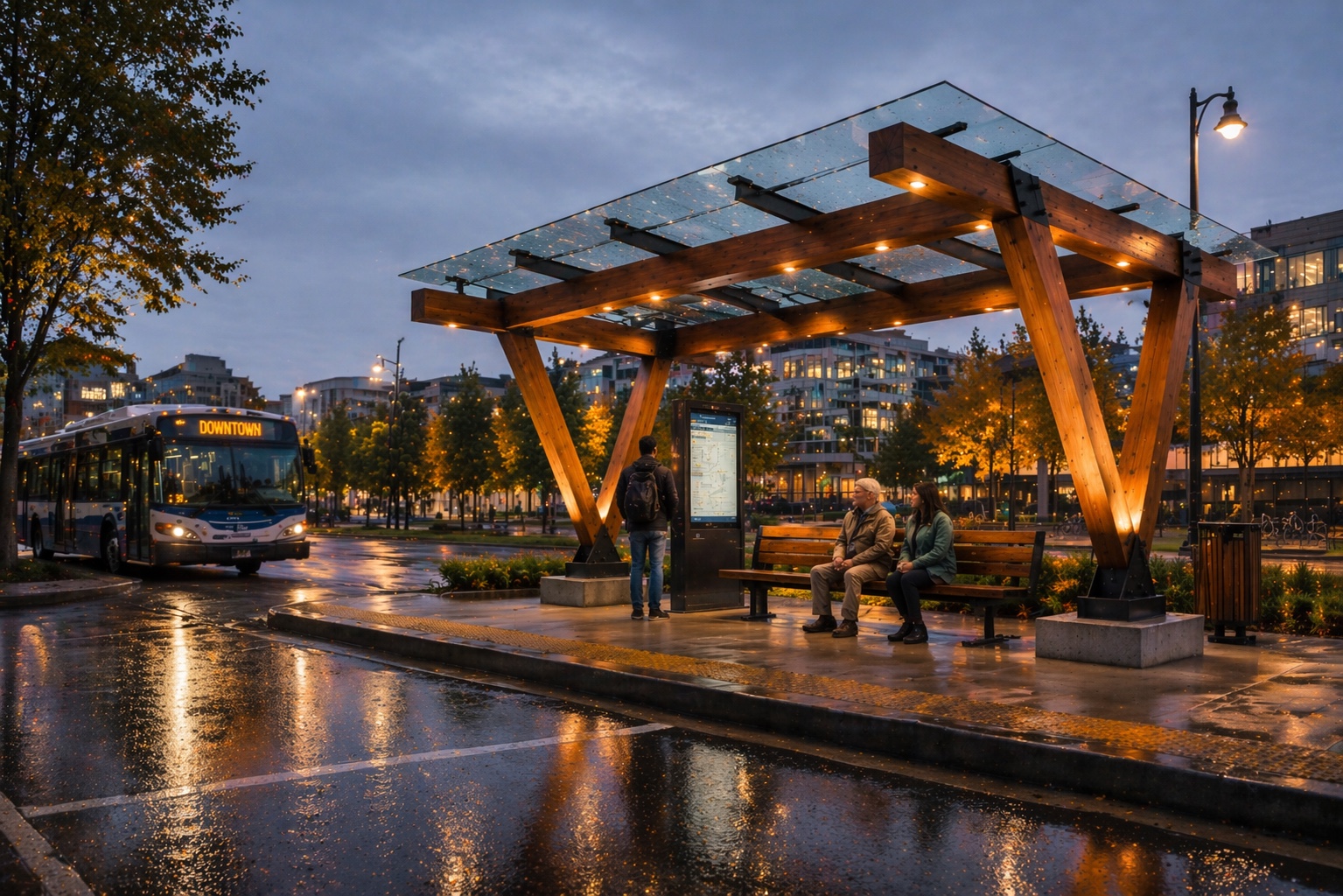
Why procurement officers are specifying heavy timber bus shelters over aluminum.
TimberShield is a bus shelter manufacturer and transit shelter supplier based in Arlington, Washington. We build heavy timber bus stop canopies, transit shelters, and park-and-ride structures for public agencies that want civic infrastructure that doesn't look like infrastructure. Engineered in Pacific Northwest #1 structural Douglas Fir, IBC-stamped, ADA-compliant, and WEBS-registered for Washington State procurement.
The US transit shelter market is dominated by modular aluminum vendors competing on rapid deployment and cooperative purchasing pricing. Their structures work. They also look identical from Seattle to Sarasota, age visibly within 15 years, and clash with historic districts and transit-oriented development aesthetics that explicitly want something better. Even WMATA acknowledged this when they specified bronze-toned shelters for historic Washington DC districts — aluminum was the wrong material for the context.
Heavy timber is the right material for the contexts where transit deserves to be part of the streetscape rather than bolted into it: TOD developments, walkable urbanism, historic neighborhood transit, civic plazas, university campuses, park-and-ride facilities at scenic destinations, and any agency where the board cares how the shelter photographs as much as how quickly it deploys.
Request Procurement Information →Procurement-ready bus shelter supplier for transit agencies and municipalities.
Public agency procurement adds layers most private projects don't have — RFP processes, small-works thresholds, cooperative purchasing agreements, AHJ-specific permitting, ADA review. TimberShield's procurement positioning reduces those layers wherever the regulatory framework allows.
Washington State vendor pre-qualification
Registered in the Washington Electronic Business Solution database — the state's primary vendor registry. WSDOT, Sound Transit, county agencies, and city departments source through WEBS by default.
Small public works & consultants
Listed on the MRSC Rosters for small public works and consultant services. Municipalities can engage TimberShield for shelter projects under the small-works threshold without the full RFP process.
Streamlined acquisition pathways
Where cooperative purchasing programs exist that match TimberShield's pricing structure, we work with procurement officers to confirm eligibility — accelerating acquisition for agencies that prefer pre-vetted vendor channels.
Permit-ready documentation
Every shelter ships with IBC-stamped engineering drawings, structural calculations, ADA clearance verification, and site plan exhibits. Procurement officers and AHJ reviewers get the full documentation package up front.
What to specify in a bus shelter RFP.
A well-structured bus shelter RFP evaluates vendors on the ten criteria below. TimberShield's standard documentation package addresses each one. Use this as a scoping reference whether you issue a formal RFP or source via cooperative purchasing.
Structural design loads
Site-specific snow, wind, and seismic loading per ASCE 7. For Washington State projects, verify 120 to 150 MPH wind and 25 to 80 PSF snow depending on jurisdiction. Request stamped engineering calculations in the vendor response.
ADA clearance requirements
Wheelchair turning radius, ground-level transitions, accessible seating height, and tactile contrast finishes. ADA Standards for Accessible Design §305 and §307 apply. Request accessibility verification documentation.
Material and finish standards
Specify timber grade and species, steel plate specifications, fastener corrosion ratings, and roof material. For historic districts, require finish samples for preservation board approval before contract award.
Foundation specifications
Concrete footing design per ASCE 7 loading, rebar schedule, embed depth, and soil-bearing requirements. Confirm whether foundations are included in the vendor scope or trade-of-record.
Electrical and conduit routing
Underground conduit for signage power, digital displays, emergency call boxes, lighting, and future solar PV. Specify at design stage to avoid field-fit improvisation during install.
Vandal resistance expectations
Define graffiti remediation cycle, anti-tag coatings or absence, surface repair protocols, and acceptable degradation thresholds. Material choice drives expectations — timber recoats, aluminum replaces panels.
Maintenance cycle requirements
Specify expected maintenance frequency, labor-hour budget, and consumable costs. Lifecycle cost evaluation depends on this. Timber recoat every 2 to 4 years; aluminum panel replacement at 15-year intervals.
Warranty terms
Structural, finish, hardware, and roof warranties with separate durations. TimberShield shelters carry a 40 to 60 year structural design lifespan with structural warranty aligned to Washington State public works standards.
Lifecycle cost evaluation
20-year total cost of ownership including installation, maintenance, replacement cycles, and disposal. Pure upfront-cost scoring favors aluminum; lifecycle scoring often favors heavy timber. Specify which the RFP evaluates on.
Procurement framework compliance
Prevailing wage compliance where required, cooperative purchasing eligibility, pre-qualified vendor status, small-works threshold eligibility, and disadvantaged business enterprise participation requirements per jurisdiction.
TimberShield's standard documentation package addresses all ten items for every quote request. Request a procurement-ready quote →
Six bus shelter and transit canopy applications we manufacture for.
Bus stops & transit centers
Sound Transit, King County Metro, Pierce Transit, and similar agencies serving walkable urban districts. The shelter fits the streetscape rather than fighting it. Riders notice the difference; boards approve faster when the design integrates with neighborhood character.
Suburban & rural transit hubs
Larger TS-44 multi-bay shelters for park-and-ride facilities at trailheads, regional transit hubs, and rural bus stops. Solar-equipped roofs handle off-grid lighting and digital displays at remote locations.
Heritage & conservation neighborhoods
Where historic preservation guidelines explicitly prohibit modern aluminum shelters, heavy timber typically passes preservation board review — particularly with custom stain finishes that match adjacent historic buildings.
Transit-oriented development
TOD developments invest heavily in pedestrian environment and walkability. Aluminum bus shelters undercut that investment. Heavy timber matches the materials palette of the surrounding architecture and supports the broader urbanism goal.
Universities & colleges
Campus shuttle stops, library entrances, dorm-adjacent transit waiting areas. The architecture aligns with campus quad aesthetics in a way that prefab aluminum never does. Particularly suited to schools with cedar-and-stone or brick-and-timber architectural vocabularies.
K–12 school district stops
Heavy timber school bus shelters for rural and suburban districts that want a permanent solution that won't be replaced every fifteen years. Same Douglas Fir construction; smaller TS-12 footprint suitable for residential street stops.
Heavy timber vs. aluminum vs. concrete vs. steel bus shelters.
An honest four-way comparison across the criteria that drive procurement decisions. No material is universally correct — each has contexts where it wins. Here is where TimberShield fits and where it does not.
When aluminum is the right call
High-volume generic urban routes where cost per shelter is the dominant procurement criterion, replacement cycles are planned into capital budgets, and architectural context is secondary. Aluminum modular shelters deploy fast, carry low upfront cost, and most procurement teams have mature supplier relationships. We will not win those bids. If that is your scenario, aluminum is correct.
When concrete is the right call
Transit stops in high-vandalism areas where panel replacement would be a chronic operating expense, or security-critical civic infrastructure where impact resistance is the primary design criterion. Concrete lasts, resists damage, and signals permanence. For most civic plazas and TOD contexts, however, concrete reads as fortification rather than welcome.
Where TimberShield wins
Contexts where the board, planning committee, or community expects more than utility. Historic districts, TOD developments, university campuses, scenic park-and-ride facilities, agency headquarters, and any procurement where lifecycle cost scoring and architectural quality carry weight. We quote honestly and recommend aluminum when it is the right answer.
Built to civic code. Engineered for the streetscape.
Structural & Code
- 10×14 Douglas Fir V-legs and cap beam
- IBC engineered for 120–150 MPH wind, 25–80 PSF snow
- Stamped engineering drawings included
- Steel base plate anchored to concrete footings
- 40–60 year design lifespan
Accessibility
- ADA-compliant clearances and turning radius
- Ground-level transitions for wheeled mobility
- Optional ADA-compliant bench mounting
- Tactile and visual contrast finish options
- Accessible signage mounting points
Technology & Information
- Real-time information display mounting points
- Digital signage and route map integration
- Underground conduit for power and data
- Emergency call box mounting
- Solar-equipped roof option for off-grid sites
Public Durability
- Vandal-resistant Douglas Fir finish
- Surface scratches sandable and recoatable
- Tinted laminated tempered glass roof (anti-graffiti)
- Optional integrated LED lighting with motion sensors
- Low-maintenance 2–4 year recoat cycle
Prefabricated for Rapid Deployment
- Fabricated at Washington Timber Company mill, Arlington WA
- Shipped palletized to site, labeled by assembly sequence
- Typical 2–4 day on-site assembly post foundation cure
- Crane access requirements documented pre-delivery
- Prefab logistics comparable to aluminum modular systems
Procurement Documentation
- IBC-stamped engineering drawings per state
- ADA accessibility verification exhibits
- Lifecycle cost analysis (20-year TCO)
- Prevailing wage compliance documentation where required
- WEBS and MRSC vendor registration numbers
"As a transit agency we had strict aesthetic requirements alongside structural engineering requirements. The Douglas Fir canopy met both. Our riders love waiting under it. Our board loves how it photographs.
Sized for every transit context.
Three configurations cover the full range of public transit shelter applications, from single-bay rural and school bus stops to multi-bay urban transit centers and park-and-ride facilities.
Standard configurations include the 24-gauge Commercial Metal Roof. Procurement upgrades available: tinted laminated tempered glass roof, real-time information display mounting, ADA-compliant bench systems, solar-powered LED lighting, vandal-resistant finishes, and custom stain colors matching adjacent civic architecture.
How much does a custom bus shelter cost?
Structure base pricing in US dollars. Full installed pricing including foundations, delivery, and installation runs higher and varies by site. Procurement-ready site-specific quotes delivered within one business day.
Pricing adders by scope
- Tinted laminated tempered glass roof: +$4,000 to $9,000 per bay
- ADA bench system: +$900 to $1,800 depending on finish and mounting
- Integrated LED lighting with motion sensors: +$1,200 to $2,400 per shelter
- Real-time information display mounting (hardware not included): +$600
- Solar PV roof system: +$3,500 to $8,000 depending on panel count and controller
- Custom stain finish for historic district compliance: +$800 to $2,200
- Foundation and site prep: site-specific, typical $3,500 to $12,000 per shelter
- Delivery and installation: site-specific, typical $4,000 to $9,000 per shelter
For a detailed 20-year total cost of ownership analysis, see our timber vs steel TCO breakdown. The same principles apply to transit shelter procurement.
The bus shelter that aligns with your agency's carbon goals.
Public transit agencies face increasing pressure to align infrastructure procurement with sustainability commitments — climate action plans, LEED requirements for public projects, embodied carbon disclosures. Heavy timber outperforms aluminum and galvanized steel across every relevant sustainability metric, and the story is well-suited to public-facing communications.
- −68% embodied carbon vs. equivalent steel shelter — measurable and reportable
- LEED credit eligibility across MR, EQ, and IN categories (verify with project consultant)
- Sustainably harvested Pacific Northwest #1 structural Douglas Fir, milled by Washington Timber Company
- 40–60 year design lifespan vs. 15–20 for aluminum modular shelters — fewer replacement cycles, less embodied carbon over the agency's planning horizon
- Solar-equipped option supports off-grid lighting and information display at rural and remote transit stops
Questions TimberShield gets from transit agencies and municipalities.
Is TimberShield WEBS-registered for Washington State procurement?
Yes. TimberShield is registered in the Washington Electronic Business Solution (WEBS) vendor database and on the MRSC Rosters for small public works and consultant services. Pre-qualified vendor status streamlines the procurement path for Washington State transit agencies, municipalities, and public agencies — bypassing certain RFP requirements where cooperative purchasing or small-works processes apply.
Are TimberShield bus shelters ADA-compliant?
Yes. All TimberShield bus shelters and transit shelters are designed to ADA accessibility standards — accessible clearances, wheelchair-turn radius accommodation, ground-level transitions, and ADA-compliant seating mounting where benches are specified. We work with your civil engineer and accessibility consultant to confirm compliance with local AHJ requirements.
Can the shelter accommodate real-time information displays and digital signage?
Yes. The cap beam includes optional integrated mounting points for real-time information displays, digital signage, route maps, and emergency call boxes. Underground conduit routing for power and data is designed into the footing layout — no field-fit improvisation. The structure supports the full range of modern transit information hardware.
How vandal-resistant is heavy timber compared to metal and glass bus shelters?
Properly finished 10×14 Douglas Fir is dramatically more vandal-resistant than glass-walled aluminum shelters. Surface marks can be sanded and recoated; structural integrity is essentially indestructible at human-scale impact. Compared to aluminum shelters that dent and develop graffiti panels that need replacement, the heavy timber finish maintenance cycle is significantly lower over a 20-year horizon — typically a recoat every 2 to 4 years.
How much does a custom bus shelter cost?
TimberShield bus shelters start at $11,900 for the TS-12 single-bay structure base, $19,800 for the TS-24 standard urban bus stop, and $34,800 for the TS-44 multi-bay transit center configuration. Pricing varies by roof selection, ADA bench systems, lighting, digital display mounting, foundation requirements, and installation logistics. Full installed pricing including foundations, delivery, and install runs higher — site-specific procurement quotes delivered within one business day.
Do you offer prefabricated bus shelters for rapid deployment?
Yes. TimberShield bus shelters are prefabricated at our Washington Timber Company mill in Arlington, WA, then shipped to site for assembly. Typical on-site assembly runs 2 to 4 days once the concrete footings have cured. The prefabricated approach gives you the aesthetic and structural quality of heavy timber with site logistics comparable to modular aluminum shelters.
How does the cost compare to standard aluminum modular shelters?
Aluminum modular shelters typically run lower upfront cost but require panel replacement, graffiti remediation, and structural refurbishment every 15 to 20 years. TimberShield shelters carry a higher initial investment and a 40 to 60 year design lifespan — total cost of ownership often favors heavy timber within the first replacement cycle. For agencies whose procurement frameworks evaluate lifecycle cost rather than upfront cost alone, timber is competitive.
Can the shelter be solar-equipped for lighting and digital displays?
Yes. The 24-gauge Commercial Metal Roof supports standard solar racking systems for PV panels. We engineer additional structural load capacity when solar is specified in the original scope. This makes TimberShield bus shelters particularly suitable for off-grid park-and-ride locations and rural transit stops where solar-powered lighting and real-time displays are operational requirements.
Are TimberShield shelters available through cooperative purchasing agreements?
TimberShield is positioning for inclusion in the major cooperative purchasing programs that serve Western US transit and municipal agencies. Where cooperative purchasing pathways exist that match our pricing structure, we work with procurement officers to confirm eligibility and streamline acquisition. Contact TimberShield directly for current cooperative purchasing arrangements and pre-qualified vendor status in your jurisdiction.
Can TimberShield ship bus shelters to the Midwest or East Coast?
TimberShield currently manufactures and installs across Washington, Oregon, California, and Arizona. For transit agencies outside the Western US, we evaluate projects case by case — larger multi-shelter orders may be viable with freight-adjusted pricing. Contact TimberShield directly with your jurisdiction and project scope and we will respond with a feasibility assessment within one business day.
What should municipalities include in a bus shelter RFP?
A well-structured bus shelter RFP should specify: structural design loads (snow, wind, seismic per site), ADA clearance requirements, material and finish standards, foundation specifications, electrical and conduit routing for signage or lighting, vandal resistance expectations, maintenance cycle requirements, warranty terms, lifecycle cost evaluation criteria, prevailing wage compliance where required, and cooperative purchasing eligibility if applicable. TimberShield responds to RFPs with full documentation packages including IBC-stamped engineering, ADA verification, and lifecycle cost analysis.
Bring architectural quality to public transit.
Send TimberShield your agency name, project type (bus stop, transit center, park-and-ride), procurement framework, and target award date. Procurement-ready quote with stamped engineering documentation within one business day.