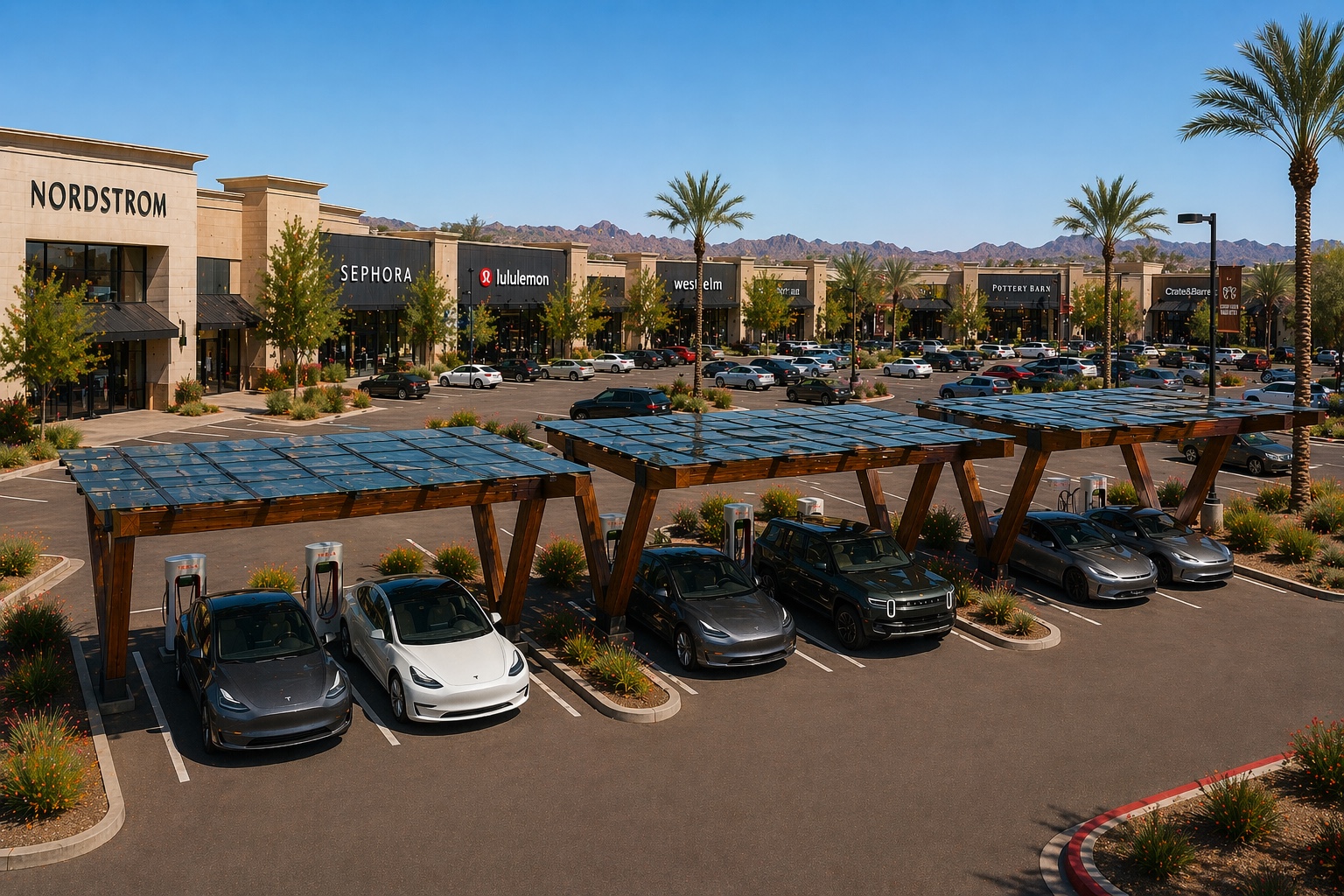
The US EV charging canopy manufacturer for properties where charging is architecture.
TimberShield is a US EV charging canopy manufacturer building heavy timber EV canopies and charger awnings for properties where charging infrastructure is a brand statement, not a back-of-house utility. Charging infrastructure, reimagined as architecture. Engineered in Pacific Northwest Douglas Fir from Washington managed forests, IBC-compliant, designed for Level 2 and DC Fast Charging deployments, and built to last 40 to 60 years — twice the replacement lifetime of a painted metal canopy.
The American EV charging canopy market is dominated by galvanized steel: fast to deploy, cheap to manufacture, ugly to live with, and replaced every 10 to 15 years as paint fails and corrosion sets in. European architectural firms like K:Port and HASSLACHER build beautiful timber canopies — but they ship from Austria with bespoke pricing, project timelines measured in months, and no presence in US procurement channels.
TimberShield is the premium US heavy timber EV charging canopy manufacturer — pre-engineered with published model pricing, available with permit-ready stamped engineering, and installed in 5 to 10 days. For retail centers, multifamily communities, luxury estates, hospitality properties, fleet depots, and municipalities, it is the only canopy that treats EV charging as architecture worth investing in.
Get a Custom Quote →EV charging canopy materials: heavy timber vs. steel vs. solar.
Three real options for covered EV charging — each suited to a different priority. Heavy timber wins on architecture and lifespan; steel competes on upfront cost; solar wins when on-site generation is the goal.
| Feature | TimberShield Heavy Timber | Galvanized Steel Carport | Solar Canopy |
|---|---|---|---|
| Design lifespan | 40–60 years | 10–15 years | 20–25 years (panels) |
| Architectural quality | High | Low | Medium |
| IBC engineered & stamped | Yes | Varies | Yes |
| Permit-ready drawings | Yes | Sometimes | Yes (+ PV permits) |
| Install timeline | 5–10 days | 3–7 days | 8–16 weeks (with PV) |
| Charger integration | Pre-engineered | Field-fit | Pre-engineered |
| Solar retrofit ready | Yes | Limited | N/A (built-in) |
| Embodied carbon | −68% vs. steel | Baseline | +15% vs. steel |
| Brand impression | Premium architecture | Utility | Sustainability |
| Maintenance cycle | Recoat 2–4 yrs | Repaint 5–7 yrs | Inverter swap ~10 yrs |
When the property wants on-site generation, solar carports earn their place. When the property wants permanent architecture and EV-readiness, heavy timber is the only category that delivers both.
Where heavy timber EV charging canopies become architecture.
Apartment & condo communities
Covered EV-ready parking that doubles as architectural amenity. Modular sizing fits any parking layout, and integrated LED soffit lighting upgrades nighttime safety. Property managers report measurable rent premiums on EV-canopied stalls. See the retrofit guide →
Lifestyle centers & malls
Nordstrom, Westfield, and lifestyle-tier centers differentiate from generic steel carports with heavy timber EV charging canopies. Customers photograph them, post them, and return because of them — and the architecture aligns with the surrounding retail brand quality.
Dealership porte-cochères & EV charging bays
Luxury dealer groups are shifting from painted steel to heavy timber for customer porte-cochères, EV charging arrays, and service drive canopies. Pre-engineered conduit routing scales with EV inventory growth over 5 to 10 years. See dealership applications →
Estates & private residences
Pacific Northwest lakefront, Scottsdale, Sonoma — premium properties with multi-bay EV-ready garages. The TS-12 works well as a residential EV charger awning for one or two home chargers; larger configurations cover multi-bay residential arrays. See residential applications →
Hotels & resort properties
Mountain lodges, coastal resorts, urban boutique hotels — EV charging as guest amenity. Heavy timber matches Pacific Northwest and mountain-resort architectural vocabularies in a way that no metal canopy can. See commercial applications →
Corporate fleet depots
Single-architecture identity across multiple fleet locations. Pre-engineered specifications and published pricing make multi-site rollouts straightforward — and the 40-to-60-year lifespan compounds the savings vs. galvanized steel replacement cycles.
Municipalities & civic centers
Park-and-ride EV charging, civic center charging, transit-adjacent charging hubs. WEBS registered for Washington State procurement, MRSC roster ready, ADA compliant. See transit applications →
Two-bay-per-V-leg geometry — designed for parking.
The TimberShield V-leg is two independent 10×14 Douglas Fir timbers anchored to a single steel base plate, each at 20°, supporting a 10×14 cap beam at 2:12 pitch. Built originally for golf practice covers and architectural canopies, the geometry is uniquely suited to EV charging parking layouts:
- One V-leg per two stalls. Stalls align cleanly between V-legs, no center posts in vehicle paths.
- 18-foot depth. Accommodates full vehicle length plus door swing plus ADA-compliant clearances.
- 9'0" rear eave, 13'6" front eave. Overhead clearance for full-size SUVs, pickup trucks, and Class 1 fleet vehicles.
- Pre-engineered charger mounting. Overhead conduit channels and stanchion mounting points designed into the structure — no field-fit improvisation.
- Modular scalability. One V-leg per bay; add bays by adding V-legs. A six-bay TS-64 is structurally identical to three connected two-bay TS-24 structures.
EV canopy installation, from site survey to charger commissioning.
Most TimberShield EV charging canopy installations run 4 to 6 weeks from signed quote to fully commissioned chargers. The structural install itself takes 5 to 10 days on-site; permit review and footing cure drive the balance of the timeline.
Site survey & design
We review your parking layout, charger count, charger brand, electrical service capacity, and site drainage. Site visit for complex deployments. Design finalized with stamped engineering drawings for your AHJ.
Permit submission
IBC-stamped drawings and site plan submitted to the Authority Having Jurisdiction. Separate electrical permit for the chargers submitted in parallel by your electrical contractor. See permit requirements by state →
Foundation pour
Concrete footings poured per stamped foundation design. Underground conduit routed during the pour to serve each future charger location — no trenching after the canopy goes up. 7 to 14 day cure before structural install.
Canopy install
Professional TimberShield crew on-site: V-leg erection, cap beam, roof installation, lighting, soffit, and finish. TS-24 installs in 2 to 3 days; TS-44 and TS-64 take 3 to 5 days. Multi-structure arrays with EX-20 extensions add 2 to 3 days per added structure.
Charger installation
Your electrical contractor pulls charger-mount hardware, runs the final conduit, mounts the chargers, and completes electrical commissioning. Chargers typically live by day 2 of this phase.
Network activation & walkthrough
Charger network activation (ChargePoint, EVgo, Electrify America, or your preferred network) completes the deployment. Final walkthrough with TimberShield included on every install.
Our V-leg system was engineered for charger integration from day one — not retrofit onto a general-purpose carport. Conduit routing, stanchion mounting, overhead clearance, and bay spacing all accommodate commercial-grade EV charging hardware out of the box.
Sized for any deployment.
Four core configurations cover most EV charging station installations from single-bay residential charger awnings through six-bay commercial canopy arrays. Custom multi-bay configurations are built by chaining base structures with EX-20 extensions.
Every model includes the 24-gauge Commercial Metal Roof. Upgrade to tinted structural laminated tempered glass, integrated lighting, gutters, and charger-mounting hardware — all quoted on the site-specific proposal. For residential EV charger awning applications, the TS-12 single-bay structure (available on the TS-12 page) is the right fit.
How much does an EV charging canopy cost?
Structure base pricing in US dollars. Full installed pricing including foundations, delivery, and installation runs higher and varies by site. Site-specific quotes delivered within one business day.
Pricing adders by scope
- Tinted laminated tempered glass roof: +$4,000 to $9,000 per bay
- Integrated LED soffit lighting with motion sensors: +$1,200 to $2,400 per structure
- Charger-mounting hardware (per charger): +$400 to $900
- Underground conduit routing (coordinated with electrical trade): site-specific
- Solar PV-ready structural upgrade: +$2,500 to $6,000 per structure
- Custom stain finish (for brand or architectural match): +$800 to $2,200
- Foundation and site prep: site-specific, typical $3,500 to $12,000 per structure
- Delivery and installation: site-specific, typical $5,000 to $12,000 per structure
For a detailed 20-year total cost of ownership analysis comparing heavy timber EV canopies to galvanized steel alternatives, see our steel vs timber TCO breakdown.
Built to commercial code. Installed in days.
Structural
- Premium #1 structural 10×14 Douglas Fir timbers
- 40° V-angle (20° per leg), 2:12 cap beam pitch
- Steel base plate anchored to concrete footings (4–8" depending on slab)
- IBC-compliant engineered for 120–150 MPH wind, 25–80 PSF snow load
- Stamped engineering drawings available for permit submittal
EV Integration
- Pre-engineered for Level 2 (7.6–22 kW) and DC Fast Charging (50–350 kW)
- Compatible with all major brands: Tesla, ChargePoint, Blink, EVgo, Wallbox, Electrify America
- Overhead charger mounting points designed into cap beam
- Underground conduit routing pre-planned during footing layout
- Integrated LED soffit lighting, optional motion sensors
Installation
- 5–10 days on-site after footings cure (7–14 day cure)
- 2–3 days for standard TS-24; 3–5 days for TS-44 and TS-64
- Professional crew — not a DIY kit, not a contractor handoff
- Final walkthrough with TimberShield included on every install
- Coordinates with your electrical contractor for charger commissioning
Code & Compliance
- IBC engineered to local AHJ (Authority Having Jurisdiction) requirements
- ADA-compliant clearances for accessible stalls
- WEBS registered for Washington State procurement
- MRSC roster ready for municipal cooperative purchasing
- Permit support included — we work with your GC or directly with the AHJ
The sustainable EV charging canopy that aligns with your carbon goals.
Electric vehicle charging is a sustainability play. The canopy covering it should be too. Clean energy deserves a clean structure. Heavy timber outperforms galvanized steel on embodied carbon, lifespan, and circular-economy metrics — and the sustainability story aligns with the EV charging brand promise.
- −68% embodied carbon vs. equivalent galvanized steel structure
- Washington managed-forest Douglas Fir harvested under state forest-practices regulations aligned with FSC sustainable forestry standards; FSC-certified wood available on request for projects requiring chain-of-custody documentation
- LEED credit eligibility across MR, EQ, and IN categories (verify with project consultant)
- Sustainably harvested Pacific Northwest #1 structural Douglas Fir, milled by Washington Timber Company
- 40–60 year design lifespan vs. 10–15 for painted metal canopies
- Solar-retrofit ready — Commercial Metal Roof supports standard PV racking
EV charging canopy questions TimberShield gets every week.
Do you supply the EV chargers themselves, or just the canopy?
TimberShield supplies the structural canopy — designed and pre-engineered to integrate any major Level 2 or DC Fast Charging hardware. You source chargers from your preferred provider (ChargePoint, Tesla, Blink, EVgo, Wallbox, Electrify America) or your electrical contractor; we coordinate overhead mounting points and underground conduit routing so installation is clean and code-compliant.
What chargers are pre-engineered to work with TimberShield canopies?
Our canopies are pre-engineered for overhead charger mounting and underground conduit routing. We have installed canopies that integrate Tesla Wall Connectors and Superchargers, ChargePoint CP6000 and Express series, Blink IQ200, EVgo, Electrify America, Wallbox Pulsar Plus, and most other Level 2 and DC Fast Charging units up to 350 kW.
How does heavy timber compare to a solar carport for EV charging?
Solar carports add an entire electrical system — PV panels, inverters, utility interconnection, PV-specific permitting — on top of the canopy structure. They make sense when the property wants on-site generation. Heavy timber canopies focus on architectural quality, structural durability, and clean charging infrastructure without the cost and lead time of solar integration. Many clients install timber canopies as Phase 1 and add solar later — our Commercial Metal Roof supports standard solar racking systems for future retrofit.
Can a TimberShield EV canopy be retrofit with solar later?
Yes. The Commercial Metal Roof metal roof supports standard solar racking systems for future PV integration. If you anticipate adding solar in a later phase, we engineer additional structural load capacity into the original specification so retrofit is straightforward.
How much does an EV charging canopy cost?
TimberShield EV charging canopy structure base pricing: TS-24 two-bay at $19,800, TS-44 four-bay at $34,800, TS-64 six-bay at $49,800, and EX-20 modular extension at $15,000. Pricing adders include roof upgrades (tinted glass, architectural fabric), integrated LED lighting, charger mounting hardware, foundation and site prep, and delivery and installation. Full installed pricing including footings, delivery, and install varies by site. Site-specific procurement quotes delivered within one business day.
What does a TimberShield EV canopy cost compared to a galvanized steel carport?
TimberShield EV canopies start at $11,900 for a single bay and scale up through multi-bay configurations. Compared to galvanized steel canopies that need replacement every 10 to 15 years as paint fails and corrosion sets in, the 40 to 60 year Douglas Fir design lifespan means total cost of ownership often favors heavy timber within the first replacement cycle — even before factoring in resale and brand-quality benefits. We provide site-specific quotes within one business day.
How long does it take to install an EV charging canopy?
Most TimberShield EV canopy projects install in 5 to 10 days on-site once footings have cured (footings take 7 to 14 days). A standard TS-24 two-bay structure installs in 2 to 3 days; larger multi-bay TS-44 and TS-64 structures take 3 to 5 days. We coordinate with your electrical contractor so charger installation happens immediately after canopy completion, minimizing total project timeline.
How is TimberShield's Douglas Fir sourced sustainably?
TimberShield canopies are built from sustainably harvested Pacific Northwest #1 structural Douglas Fir, milled by Washington Timber Company. All Washington managed forests operate under the same forest-practices rules that align with FSC sustainable forestry standards. Few mills carry FSC chain-of-custody certification because of the cost and regulatory burden, and Washington Timber Company is not currently FSC-certified. For projects pursuing LEED Material Resources credits that require certified wood with chain-of-custody documentation, FSC-certified Douglas Fir can be sourced on request. Raise this at project kickoff so we can confirm the sourcing pathway.
Can TimberShield canopies be used for commercial EV charging stations?
Yes. The TS-44 and TS-64 configurations are the standard structures for commercial EV charging stations serving retail centers, lifestyle malls, hospitality properties, corporate fleet depots, and multifamily communities. Pre-engineered for Level 2 and DC Fast Charging up to 350 kW, with overhead mounting designed for commercial-grade chargers from ChargePoint, Tesla, EVgo, Electrify America, and other major networks.
Can I use a TimberShield canopy as a residential EV charger awning?
Yes. The TS-12 single-bay structure works well as a residential EV charger awning covering one or two home charging stations. Smaller footprint than our commercial configurations but same Douglas Fir V-leg engineering and 40 to 60 year design lifespan. Common applications: covered driveway charging, garage-adjacent charging stations, and estate properties with multiple EV-ready stalls.
What is the difference between an EV canopy and an EV charger awning?
The terms are used interchangeably in most contexts. "EV canopy" or "EV charging canopy" typically refers to a larger multi-bay commercial structure covering a charging array. "EV charger awning" more often refers to a smaller single-charger or two-charger covering, often residential or small-commercial. TimberShield builds both scales from the same V-leg system — TS-12 for awning applications, TS-24 through TS-64 for canopy applications.
Ready to charge your property's future?
Send TimberShield your site dimensions, charger count, and target opening date. Site-specific itemized quote within one business day — structure, roof, charger-mounting hardware, footings, delivery, and install.