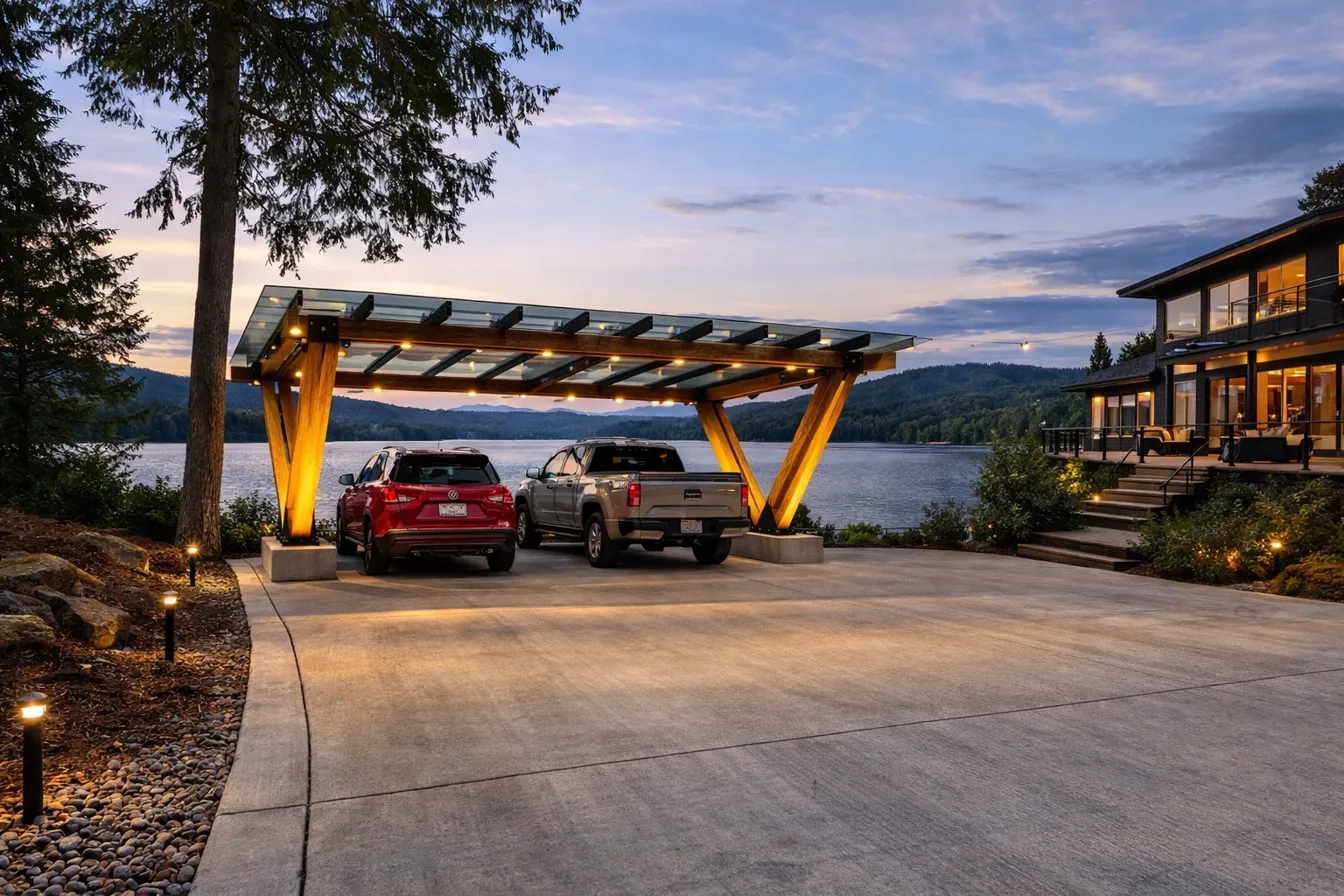
The residential canopy that's an extension of the house — not a kit bolted next to it.
TimberShield residential canopies are permanent heavy timber architecture for outdoor living. Engineered in 10×14 #1 structural Douglas Fir, IBC-stamped, professionally installed, and designed to last 40 to 60 years — long enough to be part of the home rather than an accessory to it. The structures cover poolside lounging, outdoor kitchens, dining patios, firepit areas, residential carports, spa enclosures, backyard practice spaces, and any luxury outdoor configuration where the canopy should look as considered as the rest of the architecture.
The American residential outdoor structure market splits cleanly into two categories: pavilion kits from Forever Redwood, Western Timber Frame, TIMBERKITS, and Big Timber Structures — DIY-friendly lumber assemblies typically rated for 15 to 25 years — and custom contractor builds, one-off projects with custom pricing, custom timelines, and custom risk. Both categories serve real buyers. Neither serves the homeowner who wants permanent stamped-engineered architecture with published pricing and a fixed install timeline.
That's the TimberShield buyer. Pacific Northwest waterfront estates, Scottsdale and Phoenix luxury properties, California coastal homes, Bellevue and Mercer Island residences, and any luxury home where the outdoor structure budget runs $30K to $100K+ and the homeowner expects the structure to look like part of the property when complete — not a backyard accessory.
Get a Residential Quote →One V-leg system. Every outdoor application.
Patios & entertaining pavilions
The most common residential install. A TS-24 or TS-44 covered patio extends the living space year-round, holds outdoor furniture and lighting, and reads as a designed feature rather than an awning. Pacific Northwest rain is no longer a constraint on outdoor entertaining.
Pool & spa canopies
Covered pool decks, hot tub enclosures, swim-up shade structures, and pool cabana canopies. The architectural quality elevates the pool area into a designed outdoor room — particularly suited to luxury estates where the pool is a primary outdoor feature.
Outdoor kitchens & al fresco dining
Pre-engineered for built-in grills, pizza ovens, ceiling fans, integrated lighting, and the electrical and gas runs an outdoor kitchen demands. The canopy creates the architectural envelope; your designer or contractor builds the kitchen underneath.
Covered firepit & lounge areas
Year-round outdoor seating around a firepit, gas fire feature, or chiminea. The warm Douglas Fir interior holds the heat naturally; integrated lighting and weather protection extend usability into the cold months.
Single & multi-bay carports
Permanent covered parking for one to four vehicles. Architectural carports that add appraisable property value and pass HOA review. For the general carport story, see our heavy timber carports page.
Backyard practice & activity spaces
Single-bay golf simulator enclosures, dedicated practice tees, archery setups, covered workout spaces. Ryan B. installed a TS-12 for backyard golf practice — three weeks from site visit to hitting balls in the rain. For dedicated golf practice setups, see our golf practice covers page.
Pavilion kit vs. pergola vs. TimberShield vs. custom contractor.
Four real categories of residential outdoor structure — each suited to a different priority. Pavilion kits win on DIY accessibility and price tier; pergolas win on decorative open-air; custom contractor builds win on bespoke architectural integration. TimberShield wins on permanent engineered architecture with a published timeline.
| Feature | TimberShield Heavy Timber | Pavilion Kit | Pergola | Custom Contractor |
|---|---|---|---|---|
| Design lifespan | 40–60 years | 15–25 years | 10–20 years | 15–25 years |
| Build quality | Permanent architecture | Kit assembly | Decorative | Variable |
| IBC engineered & stamped | Yes — included | Rarely | No | Rarely |
| Weather protection | Full roof system | Yes | Open slats only | Yes |
| HOA review | Typically approved | Often approved | Usually approved | Case-by-case |
| Appraisable value | Capital improvement | Improvement | Decorative | Improvement |
| EV-charger ready | Pre-engineered | No | No | Field retrofit |
| Maintenance | Recoat 2–4 yrs | Stain 2–3 yrs | Stain 2–3 yrs | Restain 2–3 yrs |
| Lead time | 8–12 weeks | 4–8 weeks | 3–6 weeks | 8–14 weeks |
| Published pricing | Yes | Yes | Yes | One-off bids |
| Resale-photo ready | Architectural feature | Backyard feature | Backyard feature | Variable |
Why heavy timber is a capital improvement, not a backyard accessory.
Residential appraisers distinguish between permanent improvements that add to the home's appraised value and decorative accessories that don't. The distinction usually comes down to three factors: permanence (is the structure built to last as long as the house?), engineering (is it permitted and stamped?), and integration (does it read as part of the property?).
Heavy timber canopies satisfy all three. The 40 to 60 year design lifespan exceeds the typical residential ownership cycle. IBC-stamped engineering and permit-ready documentation make the structure a code-compliant improvement. And the Douglas Fir architectural quality — particularly with custom stain finishes matched to the home — integrates as part of the property rather than as an addition to it.
Several of our residential clients have reported appraisal upticks specifically attributed to the canopy structure, and luxury real estate listings featuring TimberShield canopies routinely use them as primary photography. The structure becomes part of the home's story, not an asterisk in the description.
"We evaluated steel carports, wood pergolas, and three other vendors. TimberShield was the only one that could provide stamped engineering for our permit and actually looked good doing it.
One structural geometry. Every residential configuration.
The TimberShield V-leg system was engineered for permanent installation across every application — and it scales naturally into residential contexts. Two independent 10×14 Douglas Fir timbers anchored to a single steel base plate, each at 20°, supporting a 10×14 cap beam at 2:12 pitch. Two bays per V-leg, no center posts, 18-foot depth, 13'6" front eave clearance.
- 18-foot depth. Full vehicle plus doors, or a full outdoor dining setup with sofa, table, and circulation space, or a pool deck with lounge chairs and shade coverage.
- 12-foot modular bay width. Sized perfectly for one car, one outdoor sofa grouping, one pool lounge area, or one residential dining table.
- 13'6" front eave clearance. Handles tall vehicles (lifted trucks, SUVs), full-height garage doors, second-story window visibility, and overhead ceiling fans or fixtures.
- Pre-engineered for utilities. Overhead electrical, gas lines, lighting circuits, ceiling fans, integrated heating, and EV charger mounting all designed in during engineering rather than retrofit.
- Custom finish to home. Stain selected to coordinate with siding, trim, or stone work; cap beam detailing matched to architectural vocabulary; finish coordinated with adjacent millwork.
Sized from single-bay to luxury estate.
Four configurations cover the full residential spectrum, from a single-bay backyard pavilion to a multi-bay luxury estate carport. The 18-foot depth and 12-foot bay width work equally well for vehicles, outdoor furniture, dining configurations, and pool deck layouts.
Every model includes the 24-gauge Commercial Metal Roof metal roof. Residential upgrades: tinted laminated tempered glass roof (premium daylight without UV), integrated dimmable LED lighting, custom stain finishes to home, integrated heating, gutter and downspout systems, side wind screens, ceiling fan mounting, and pre-engineered EV charger integration.
From site visit to hitting balls in three weeks.
"Shawn came out for a site visit, measured everything, and had a quote in my inbox the next morning. Three weeks later I was hitting balls in the rain. No drama, no delays, exactly what was quoted.
Ryan B.'s timeline isn't typical — three weeks is fast even by TimberShield standards. Most residential projects run 8 to 12 weeks from contract to completed install: engineering and permit submittal (1 to 4 weeks depending on AHJ), fabrication and shop finishing (3 to 5 weeks), site preparation and footing cure (1 to 2 weeks), on-site install (2 to 5 days).
What's typical is what Ryan describes: a clear site visit with measurements, a written quote the next business day, no surprise delays, and a finished install that matches the quoted spec. The pre-engineered system removes the variables that make custom contractor builds run long — material sourcing, one-off engineering, on-site fabrication problems, change-order escalations.
For Pacific Northwest projects with a target spring or summer completion date, plan to sign by November or December of the prior year. For Arizona and California projects without significant weather constraints, the timeline is more flexible — TimberShield quotes specific completion dates against your project context during the site visit.
Questions TimberShield gets from homeowners.
How does a TimberShield residential canopy compare to a pavilion kit?
Pavilion kits from Forever Redwood, Western Timber Frame, TIMBERKITS, and Big Timber Structures are designed as DIY or light-contractor assemblies — typically pine, fir, or redwood lumber in standardized configurations with 15 to 25 year design lifespans. TimberShield is permanent architecture: 10×14 #1 structural Douglas Fir timbers, IBC-stamped engineering, professional installation, and a 40 to 60 year design lifespan. The two categories serve different buyers — pavilion kits for the homeowner who wants a backyard feature project, TimberShield for the homeowner whose project is permanent architecture integrated with the home itself.
Can the canopy be customized to match my home's architecture?
Yes. Custom stain colors specified to match adjacent siding, trim, or stone work; finish details engineered to match cedar-and-stone, brick-and-timber, or modern minimalist architectural vocabularies; cap beam detailing coordinated with your architect or designer. The V-leg system is the structural standard; the visible finishes are tailored to each property. We work directly with your residential architect or designer during the engineering phase to align the canopy with the home.
Will my HOA approve a TimberShield canopy?
TimberShield canopies pass HOA architectural review more easily than metal carports, fabric structures, or generic pavilion kits — the heavy timber aesthetic typically aligns with luxury residential design guidelines. We provide stamped engineering drawings, structural calculations, and rendered visualizations specifically formatted for HOA architectural review boards. Several of our clients have used our documentation package to gain approval in neighborhoods that had previously denied other covered-structure proposals.
Will it survive Pacific Northwest winters and Arizona heat?
Yes. Every TimberShield canopy is IBC-engineered to local AHJ requirements — typically 120 to 150 MPH wind exposure and 25 to 80 PSF snow load for Pacific Northwest installations, and high UV and thermal cycling for Arizona and Southern California. The V-leg geometry and Douglas Fir construction handle the structural demands; the penetrating oil finish handles the weathering demands. Properly maintained installations show no climate-driven degradation through year 30 and beyond.
Can I add EV charging, an outdoor kitchen, or heating to the canopy?
Yes to all three. The canopy is pre-engineered for overhead electrical, underground conduit routing, and structural mounting of heating equipment, ceiling fans, and lighting. EV charging integrates the same way as the structure does for any other commercial install (see our EV Charging Canopies page for the full story). Outdoor kitchens, fire features, hot tubs, spa enclosures, and integrated audio all work as engineered additions. Coordinate with your architect or designer during the planning phase so all utilities are designed in rather than retrofit.
What does a residential project timeline look like?
Plan 8 to 12 weeks from signed contract to completed install for a standard residential project. That includes site visit and engineering (1 to 2 weeks), permit submittal and approval (2 to 4 weeks depending on AHJ), fabrication and shop finishing (3 to 5 weeks), footing installation and cure (1 to 2 weeks), and on-site install (2 to 5 days depending on configuration). For projects without permit requirements (some accessory structures qualify), the timeline compresses to 6 to 8 weeks. Ryan B. went from site visit to hitting balls under his canopy in 3 weeks.
How does this compare to hiring my contractor to build a covered patio?
Custom contractor-built covered patios run on the same general construction timeline (8 to 14 weeks) and typically cost more than a TimberShield install of comparable size, because the contractor is sourcing materials, engineering one-off, fabricating on-site, and assuming all the risk for a structure they have not built before. TimberShield ships a pre-engineered system with published pricing and stamped drawings — your contractor or GC pours the footings, we deliver and install the structure, and the project is complete in days rather than weeks. Several of our residential clients have used their own GC for footings and site coordination while TimberShield handles the structure.
Bring permanent architecture to your outdoor space.
Send TimberShield your property details, intended use, target dimensions, and timeline. Site visit (where reasonable), itemized quote within one business day — structure, roof option, finish, custom architectural integration, footings, delivery, and install.