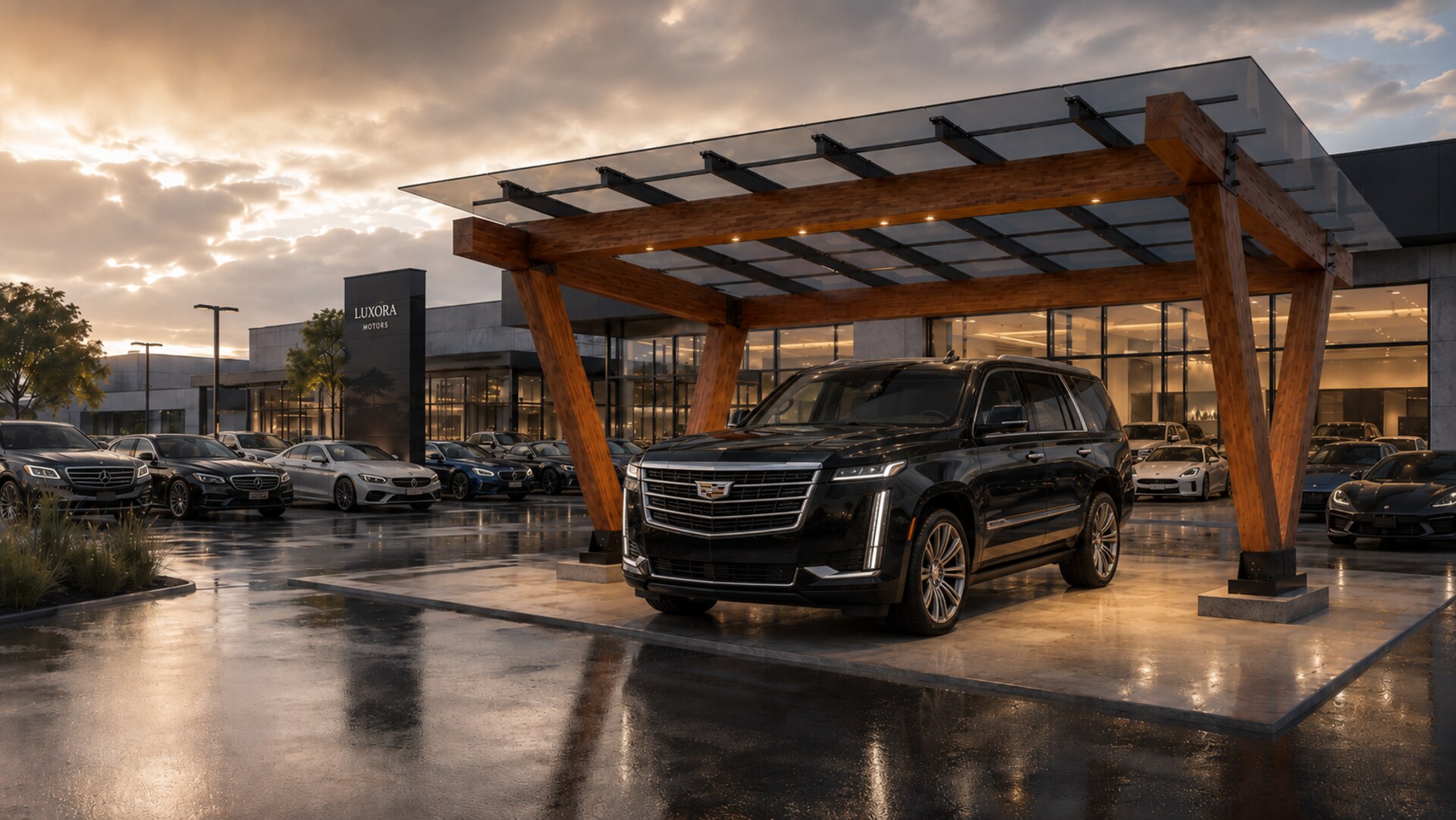
Why Heavy Timber Is Winning the Luxury Auto Dealership Canopy Market
Walk into a Range Rover, Porsche, or Cadillac dealership built in the last five years and you'll notice something. It's not the vehicles — those have always been premium. It's the architecture around them.
Premium marques have been in a decade-long arms race over dealership design. Glass curtain walls. Warm-wood interior finishes. Architectural entrance canopies. Curated landscape lighting. This isn't accidental. Luxury automotive brands have realized what their retail counterparts figured out fifteen years ago: the physical building is a marketing asset, not a cost center.
And nowhere is that shift more visible than at the curb — where the first thing a customer arriving in an $80,000+ vehicle sees is the dealership's entrance canopy.
The problem: most dealership canopies are still painted steel. Commodity infrastructure dressed up with brand-color powder coating. They look fine on day one. By year fifteen, they need replacing.
Heavy timber V-leg canopies are winning this market for a specific set of reasons. Here's what dealer principals, dealership architects, and dealer group operators are learning.
## The Real Reason Dealership Architecture Matters Now
Automotive is undergoing the most significant retail transformation in a generation. EV adoption is accelerating. Younger buyers are researching more before ever setting foot in a showroom. Direct-to-consumer sales models are pressuring franchise dealers.
The dealerships winning this environment are the ones that have stopped competing on price and started competing on experience. That means the physical building matters more than it has in decades — because it's one of the few competitive levers left where a franchise dealer can genuinely differentiate.
Every luxury marque — from Range Rover to Cadillac, Porsche to Lexus, BMW to Mercedes to Genesis — is investing in architectural upgrades to their dealer network. Brand-guideline documents from the OEM increasingly specify materials, aesthetic tone, and design continuity. The old approach of "paint it in brand colors and call it done" isn't sustainable anymore.
That's the environment TimberShield's [auto dealership canopy vertical](/applications/dealership) is built for.
## Painted Steel vs. Heavy Timber — The Real Comparison
The commodity canopy market has one dominant material: painted steel. It's cheap upfront, quick to fabricate, familiar to permit reviewers, and works for basic weather protection.
But it has three real problems for premium dealership applications.
**First, painted steel telegraphs commodity.** No matter how much you spend on the paint, it still reads as fabricated infrastructure. Customers unconsciously read finish quality — glass, timber, and stone read as permanent; painted metal reads as temporary. When a luxury dealership wraps its brand around commodity infrastructure at the entrance, it undermines the brand promise inside.
**Second, painted steel has a 15-20 year replacement cycle.** Paint fades. Rust bleeds through fasteners. Coastal salt exposure accelerates degradation. Dealerships end up rebuilding their entrance canopy every 18 years on average — a capital expense that doesn't build equity in the property, just maintains it.
**Third, painted steel is difficult to upgrade for EV infrastructure.** Adding chargers means opening up the base plates, running conduit externally or through retrofitted paths, and often bolting on visible electrical infrastructure that fights the aesthetic.
Heavy timber V-leg canopies fix all three problems.
The timber itself — Douglas Fir milled at TimberShield's Washington Timber Company mill, which has [operated continuously since 1977](/about) — reads as permanent architecture. Structural glass or metal roofing above; steel base plates powder-coated to brand color below; integrated conduit routing for chargers and lighting built into the [signature V-leg geometry](/vleg) from the design phase.
The result reads as intentional design, not commodity fabrication.
## The EV Story No One's Telling Right Now
The EV percentage of new dealer inventory is climbing fast. GM, Ford, Stellantis, Volkswagen, Hyundai, Honda — every major manufacturer has committed to EV lineup expansion. For dealerships, that means charging infrastructure at the property level is no longer optional.
But most dealerships are approaching EV infrastructure the way they've always approached parking additions: bolt something on when needed. Add a Level 2 charger here, a DC Fast Charging pedestal there, cover them with whatever's available.
That works for one or two chargers. It breaks down when a dealer needs six, twelve, or twenty charging bays across a lot.
A properly designed timber canopy solves this from day one. Every TimberShield V-leg canopy is pre-engineered with conduit paths routed through the cap beam and down through the V-legs to base-plate junction boxes. Level 2, DC Fast Charging, and solar panel roof upgrades are all accommodated — not as retrofits, but as first-principle design decisions.
A multi-bay TS-44 or TS-64 configuration can host four to six charging pedestals under a single architectural canopy. The customer arriving at the charging bay sees a design statement, not a rack of infrastructure. As EV percentage grows, the dealership adds chargers without adding structures.
That's the difference between a facility that grows with EV adoption and one that requires constant retrofitting.
## Six Ways Luxury Dealers Are Deploying Heavy Timber
The dealer principals and group operators leading this transition typically start with one of six specific applications:
**Customer porte-cochères.** The signature entrance canopy over the customer drive. First impression, brand statement, weather protection. Typically a TS-24 or TS-44 configuration with tinted structural glass roof for architectural lighting continuity.
**EV charging bays.** Multi-bay canopies over Level 2 or DC Fast Charging arrays. Solar-panel-ready roof options available. Brand-colored base plate accents. Scales with EV growth over 5-10 years.
**Featured inventory covers.** Premium standalone canopies over the flagship or newest-model inventory. Elevates $80K+ vehicles above the general lot. Frames the vehicle like a showroom piece — but outdoors, visible from the road.
**Service drive canopies.** Wide-span TS-64 configurations covering service intake bays. Integrated lighting, heaters for cold-weather service starts. Weather protection for customers dropping off vehicles.
**Delivery and detail bays.** Dedicated canopy for new-vehicle delivery ceremonies. Creates a photo-ready moment for the customer handoff. Protected from weather, branded with dealership identity.
**Employee and loaner covered parking.** Multi-bay carport structures for staff parking and courtesy fleet vehicles. Because employees notice architectural quality, too — and it signals to walk-in customers that the dealership invests in its people.
Full details on each application at [evtimbershield.com/applications/dealership](/applications/dealership).
## The Financial Case for Heavy Timber
A properly executed heavy timber canopy costs more upfront than painted steel. That's not disputed.
But dealer group CFOs and property owners run the math differently than facility managers do. Here's how the actual analysis works:
**Design life:** TimberShield canopies are engineered for 40-60 years. Painted steel canopies typically require replacement or major refurbishment every 15-20 years. That means over a 50-year property horizon, a timber canopy is a single capital deployment. A steel canopy is a first deployment plus two full replacements. When you calculate lifetime cost — not day-one cost — timber comes out ahead every time.
**Property value contribution:** Heavy timber architecture reads as permanent improvement on a property appraisal. It affects capitalization rate calculations and enterprise value at sale. Painted steel canopies are typically treated as depreciating fixtures.
**Insurance and warranty structure:** Structural steel connections carry 10-year warranties. Douglas Fir timber against structural defects: 5 years. Roof panels carry manufacturer warranties of 10-20 years depending on system. Fabric canopies carry 5-year workmanship warranties. These stack well against a painted metal canopy's typical 5-year finish warranty.
**Brand equity contribution:** Harder to measure, but real. Every dealer principal running a luxury franchise operates on some version of a brand-equity-in-property calculation. Architectural quality shows up on that ledger.
Combine those factors and the ROI comparison over 20-30 years typically favors the heavier upfront investment. Especially for luxury franchises where brand permanence is baked into how the OEM evaluates dealer performance.
## Where to Start
If you're a dealer principal, dealership architect, or dealer group operator thinking about a canopy project — for a new build, a service drive upgrade, an EV rollout, or a full property refresh — the first conversation is usually cheap and specific.
TimberShield offers custom quotes within 1 business day. Every project starts with a site walk-through and structural assessment. From there: engineering package (1-2 weeks), permit review (varies by AHJ), footings and install (typically 6-10 weeks total from contract to installed).
Multi-location dealer groups get consolidated project management — one design cycle, one procurement stream from our mill, staged rollouts across 12-24 months.
Every TimberShield canopy is engineered to IBC standards, built from Douglas Fir at our own Washington Timber Company mill (operating since 1977), and installed by our own crew. One integrated supply chain. Guaranteed materials. Brand-matched finishes.
Architecture your customers see. Engineering they don't have to think about.
Serving auto dealership groups across Washington, Oregon, California, and Arizona.
Have a project that fits this brief?
Send dimensions, site photos, and a one-line description. TimberShield handles design assist directly — quote turnaround is typically same-day.