Fabric vs. Metal vs. Glass: Choosing Your Canopy Roof
Three roof options, three different jobs. The right choice depends less on preference than on the specific problem the canopy needs to solve.
The most common scoping question we get after "how much does it cost" is "which roof should I choose?" There's no universal right answer. Each of the three roofs — metal, glass, and fabric — is engineered for a specific job. Choosing well means matching the roof to the problem the canopy needs to solve.
Quick decision matrix
Before the deep dive, here's the pattern we see across projects:
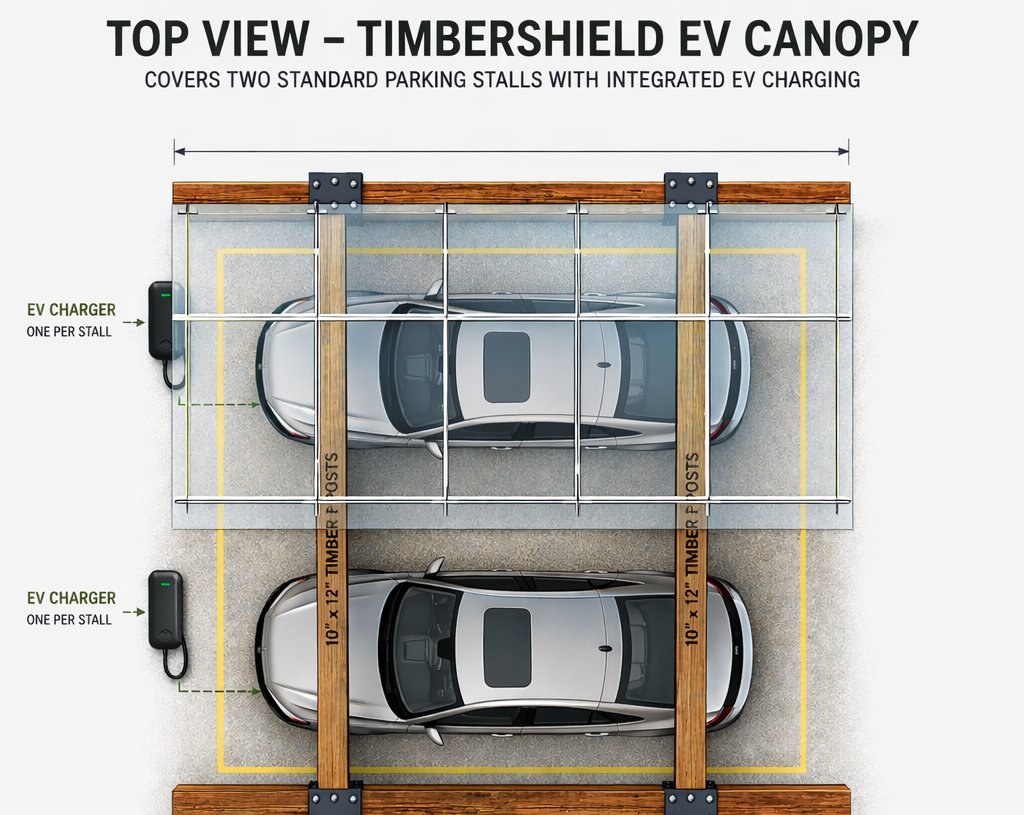
- EV charging in the PNW: Metal roof (rain shedding, low maintenance, hardest-wearing)
- EV charging in AZ/NV: Metal or fabric (both work; fabric adds heat reduction under canopy)
- Golf driving range: Fabric (acoustics, light transmission, branding included)
- Hotel porte-cochère: Glass (upscale signal, architectural lighting)
- Restaurant patio: Fabric (acoustics dramatically better for dining)
- Transit shelter: Metal (lowest maintenance, no vandalism concerns)
- Corporate walkway: Fabric or metal (depending on aesthetic intent)
- Multifamily EV charging: Metal (maintenance-free, no manager attention)
If your application isn't listed, keep reading. The full analysis often changes the intuition.
24-gauge Commercial Metal Roof — the default
Included in every base canopy price. This is the default because it's the right answer for most applications.
Specifications. 24-gauge galvanized steel, standing-seam profile, Kynar 500 paint finish available in six colors. Panel width 16" or 20". Attached to cap beam with concealed clip system (no exposed fasteners on visible surfaces).
Best applications. Anywhere the canopy job is primarily weather protection and aesthetics aren't the driver. EV charging, transit shelters, drive-thrus, corporate walkways, maintenance-heavy environments.
Advantages. Lowest first cost. Longest lifespan of the three options (30-40 years before re-coat needed). Handles snow loads well due to smooth surface (snow slides off). Zero maintenance in first 15+ years. Fire resistance rating is highest of the three.
Tradeoffs. Acoustic amplification is significant in rain and hail (this matters for restaurants and golf ranges). No light transmission. Reads as industrial in high-design contexts. Thermal mass creates cold-underside condensation in humid climates (mitigated by cap beam detailing but not eliminated).
Cost: Included in every base price. No upgrade.
Tinted Structural Laminated Tempered Glass — the premium
The upgrade path for hospitality, retail, and high-design commercial applications where visual quality matters.
Specifications. Two 6mm tempered glass panels laminated with a PVB interlayer. Available tints: clear, light grey, dark grey. UV blocking 99.9%. Load-rated for full snow loads. Wind-tested to 130 mph.
Best applications. Hotel porte-cochères, retail entry canopies, upscale restaurant patios, luxury residential, corporate lobby extensions. Anywhere the canopy is part of the architectural first impression.
Advantages. Highest visual quality. Light transmission (60-80% depending on tint) creates a bright, open feel underneath. Architectural lighting integrated below reads intentionally through the glass at night. Signals investment and quality.
Tradeoffs. Most expensive of the three options. Requires periodic cleaning (once quarterly minimum for street-level installations). Highest lifetime maintenance cost due to inevitable panel replacement over 40-year lifespan. Slightly less energy-efficient than metal in cooling climates.
Cost: +$8K (TS-12) to +$22K (TS-64) over the base metal roof.
Architectural Fabric — the branded upgrade
PVDF/PVC commercial architectural membrane. The choice for applications where custom branding is part of the value proposition, or where acoustic comfort matters.
Specifications. Commercial PVDF (polyvinylidene fluoride) coating over a PVC base. Tensile strength 600 lb/in warp, 550 lb/in fill. Translucency 12-15%, opacity tunable. UV-blocking 99.9%. Self-cleaning under rainfall. Design life 15-20 years before re-skin.
Best applications. Golf driving ranges (acoustics dramatically better than metal, branding included). Restaurant patios (same acoustic argument). Retail and hospitality (custom branding as architecture). Corporate campuses (custom color/pattern per building). Anywhere brand expression is part of the canopy's job.
Advantages. Custom branding is included at no additional cost — dye-sublimation or UV-print onto the membrane. Course logos, sponsor branding, hospitality graphics. Two-sided printing (different graphics topside and bottomside) at no premium. Acoustic damping is dramatic. Softer light quality underneath. Reduces heat load by 20-30% versus metal in sunny climates.
Tradeoffs. Membrane re-skin required every 15-20 years (vs 30-40 for metal). Less snow-shedding than metal (matters in high-snow climates — coordinate with structural engineer). Not the right choice for maximum weather-tightness in wind-driven rain climates.
Cost:
- TS-12: +$3,000
- TS-24: +$4,500
- TS-44: +$9,000
- TS-64: +$13,500
- EX-20 extension: +$4,500 per module
Custom branding is included at these prices. No separate print fees, no setup charges, no minimum graphic complexity.
Climate considerations by roof
Beyond application, the climate drives the choice:
Pacific Northwest wet climates: Metal wins on rain shedding and low maintenance. Glass is fine but requires more cleaning. Fabric works but re-skin cycles are on the shorter end due to persistent moisture cycling.
Snow country (Cascades, Rockies): Metal is the strongest choice — snow slides off, no membrane fatigue from ice loading. Glass requires enhanced snow load engineering. Fabric requires careful load path analysis.
Arizona / Nevada sun climates: Fabric reduces underside heat load significantly. Metal gets very hot in direct sun (radiant heat down through cap beam). Glass performs middle-of-pack; tinted glass helps.
Coastal (Bay Area, Puget Sound waterfront): Metal with premium paint finish is essential (salt spray). Glass is fine with regular cleaning. Fabric works but reduce membrane life expectation by 15-20% due to salt-driven degradation.
The aesthetic layer
Beyond function, each roof has a different visual character:
Metal reads utility. Standing-seam profile can be refined but still signals industrial-adjacent. Best in contexts where the timber V-Leg is the visual star and the roof is supporting cast.
Glass reads investment. Says premium. Works when the client wants the canopy to be part of the brand statement. Failure mode when used badly: reads pretentious in low-context settings.
Fabric reads expression. Best when the client wants the canopy itself to communicate something — a brand, a mood, a color palette. Custom branding included is a real differentiator that's hard to overstate.
Maintenance comparison
Rough 40-year maintenance profiles (per TS-44 sized structure):
- Metal: $2-4K total across 40 years. Wash annually, re-paint at year 25-30.
- Glass: $8-14K total across 40 years. Clean quarterly, replace 1-2 panels for damage over lifespan.
- Fabric: $10-16K total across 40 years. Wash annually, full re-skin at year 15-20 and again at year 30-35.
Metal is the low-maintenance leader by a wide margin. This is why we default to it in EV charging and transit applications where operator attention is limited.
The framework for choosing
Two questions cut through the analysis:
Question 1: What's the canopy's primary job? If it's weather protection, choose metal. If it's brand expression or acoustic comfort, choose fabric. If it's architectural quality signal, choose glass.
Question 2: How much maintenance attention will this get? If you're going to inspect and touch up annually, glass or fabric can work. If it needs to be install-and-forget, choose metal.
Answer those honestly and the roof choice becomes obvious. Bring the answers to a scoping call — TimberShield walks through the tradeoffs for your specific site and application, and typically has a quote within a day.
Have a project that fits this brief?
Send dimensions, site photos, and a one-line description. TimberShield handles design assist directly — quote turnaround is typically same-day.