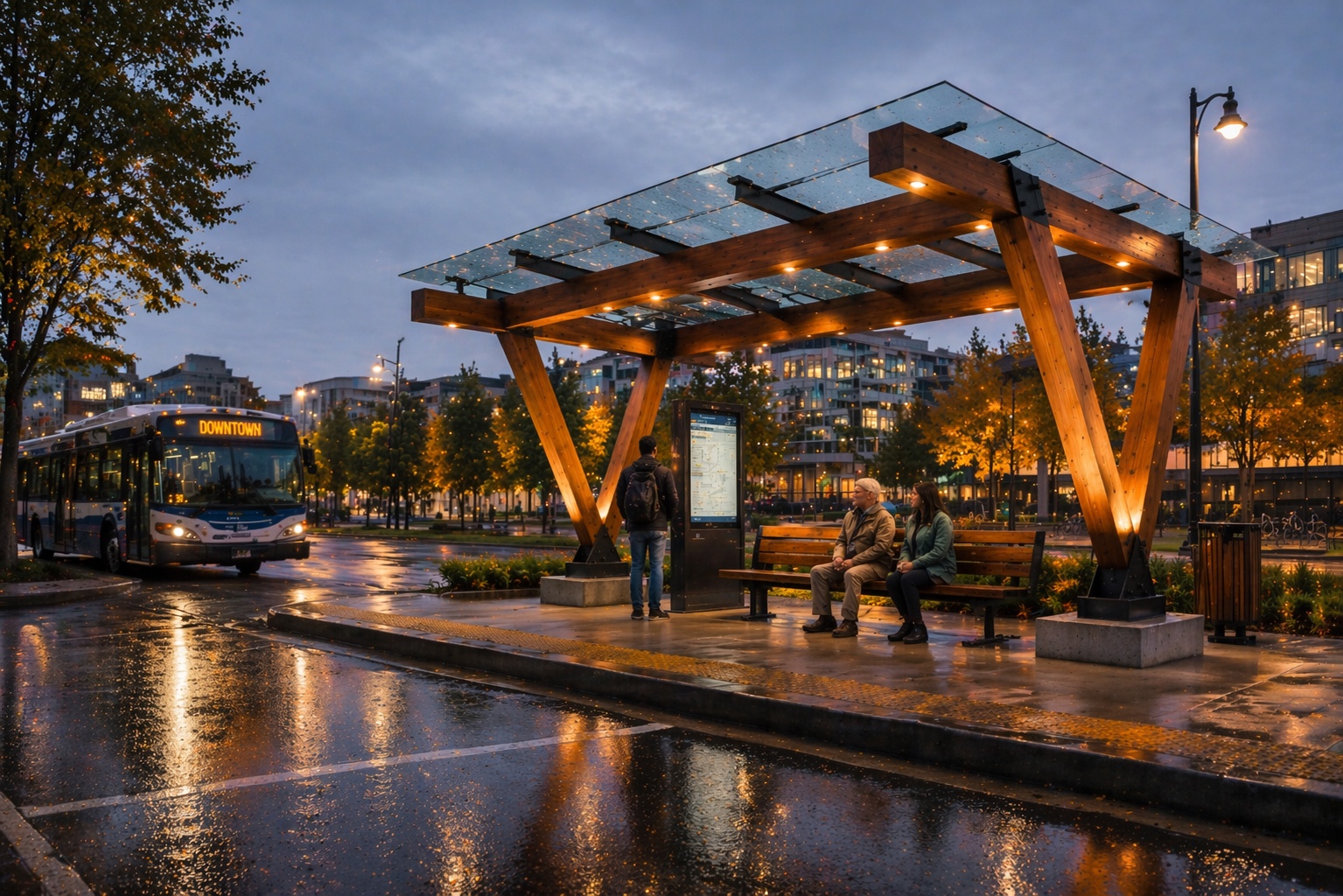
The Complete Bus Shelter Procurement Guide for Transit Agencies
A step-by-step framework for the agencies, municipalities, and school districts buying bus shelters in 2026. Procurement stages, cost ranges, material comparison, compliance, and the three decisions that determine procurement outcome.
A procurement officer at a US transit agency typically buys bus shelters every seven to twelve years. By the time the next cycle comes around, the staff who ran the last one have usually moved on, the specifications have aged out, and the vendor landscape has shifted. This guide covers the complete bus shelter procurement process end to end, from the moment an agency decides it needs new shelters through the point where the structures are installed and operational.
Why bus shelter procurement is different from other transit infrastructure
Bus shelters sit at an awkward intersection of transit infrastructure, civic architecture, and public amenity. They have to meet structural engineering standards, ADA accessibility requirements, procurement regulations, and increasingly explicit aesthetic expectations tied to historic districts, transit-oriented development, and campus master planning.
Procurement officers who have run signal controller or vehicle procurements often expect bus shelter procurement to work the same way. It usually does not. Shelters involve more stakeholders (facilities, operations, planning, legal, often an outside architect), more compliance surfaces (IBC, ADA, prevailing wage, Buy America or Buy Clean), and more lifecycle math (aluminum replaces at 15 to 20 years, heavy timber lasts 40 to 60) than most agency procurements the team sees.
Three structural differences matter:
Lifecycle cost dwarfs upfront price. A $12,000 aluminum shelter with a 15-year replacement cycle has a different 40-year ownership cost than a $19,000 timber shelter with a 50-year design life. The lifecycle math usually favors durability.
Aesthetic standards are explicit now. Transit-oriented development ordinances, historic district commissions, and campus planning standards increasingly specify material and finish requirements. The old assumption that any shelter will do is dead.
Vendor pre-qualification matters more. Shelter vendors range from large modular aluminum manufacturers to specialty heavy timber fabricators to custom concrete prefabricators. The pre-qualification filter determines which of those vendor categories ends up competing for the award.
The seven stages of bus shelter procurement
A full procurement cycle runs 16 to 32 weeks from "we need shelters" to "shelters are operational." Here is what happens at each stage.
Stage 1: Need identification and scoping (2 to 4 weeks). Facilities or operations identifies a shelter replacement need. Planning adds capital-project context. The initial scope defines shelter count, locations, and target delivery sequence. For a staged rollout across multiple fiscal years, this stage includes capital planning committee review.
Stage 2: RFP development (2 to 4 weeks). Procurement, legal, and the project team draft the Request for Proposals. For a vendor-neutral RFP, this stage includes developing performance-based specifications, lifecycle cost evaluation criteria, vendor pre-qualification requirements, and the response format. Our full bus shelter RFP guide covers the 11 required sections.
Stage 3: RFP release and bid period (3 to 6 weeks). Procurement releases the RFP through the agency's procurement system. Vendors ask questions during the Q and A window. Addenda clarify specifications. The bid deadline closes.
Stage 4: Evaluation and award (2 to 4 weeks). Pre-qualification review filters out ineligible bidders. Evaluators score the remaining bids against the published criteria. Short-list interviews happen if the RFP calls for them. The evaluation committee recommends an award. The procurement committee or board approves.
Stage 5: Contract execution and purchase order (1 to 2 weeks). Legal finalizes the contract. The vendor returns signed documents and insurance certificates. The agency issues the purchase order.
Stage 6: Vendor engineering, fabrication, and site prep (6 to 14 weeks). The vendor completes IBC-stamped engineering drawings. Permit submittal happens in parallel. Fabrication begins. On the agency side, site preparation and foundation work proceed in parallel.
Stage 7: On-site assembly and commissioning (2 to 5 days per shelter). Vendor crew installs the structure. Electrical trades complete lighting, display, and conduit terminations. Final walkthrough confirms as-built matches drawings.
Cooperative purchasing pathways eliminate stages 3 and part of 4, reducing the cycle by 5 to 10 weeks. A pre-qualified vendor on a cooperative contract can go from need identification to installed shelter in 10 to 16 weeks.
Build versus buy: custom timber vs. modular aluminum
Two categories of shelter vendor dominate the US market, and the choice between them determines most downstream procurement outcomes.
Modular aluminum manufacturers fabricate standardized shelter kits in large-volume factories, ship them nationally, and offer short lead times. Pricing is competitive and procurement cycles are fast. The tradeoff is appearance (shelters look identical across every agency using them), replacement cycle (15 to 20 years), and limited customization. For high-volume agencies with uniform routes and tight capital budgets, modular aluminum is the standard choice.
Custom timber and prefab concrete fabricators build to spec rather than from catalog, carry longer design lives, and offer architectural flexibility. Pricing is higher upfront but lifecycle cost is often lower. The tradeoff is lead time (fabrication-to-install adds 4 to 8 weeks over modular) and vendor concentration (fewer qualified bidders means more careful pre-qualification). For agencies with aesthetic standards, historic district requirements, transit-oriented development projects, or multi-decade capital planning horizons, custom fabrication is competitive.
The right answer is usually a mixed fleet strategy: modular aluminum for high-volume commuter routes where uniformity is a feature; custom heavy timber for signature stations, transit-oriented development anchors, historic district routes, and park-and-ride facilities at scenic destinations.
What a bus shelter actually costs
Shelter pricing varies by size, material, roof, lighting integration, display mounting, foundation, and location logistics. Realistic ranges for the US market in 2026:
Entry-level modular aluminum, single bay: $4,000 to $8,000 structure base, $8,000 to $14,000 installed. Covers one or two riders, basic roof panel, no integrated electrical.
Mid-range modular aluminum, three-sided: $8,000 to $14,000 structure base, $14,000 to $22,000 installed. Includes basic lighting pre-wire and standard roof.
Entry-level heavy timber, single bay: $11,900 to $19,800 structure base, $19,000 to $32,000 installed. Washington managed-forest Douglas Fir, Commercial Metal Roof, IBC-stamped engineering.
Mid-range heavy timber, two to three bays: $19,800 to $34,800 structure base, $32,000 to $55,000 installed. Multi-rider capacity, ADA bench, LED soffit lighting, digital display mounting ready.
Flagship heavy timber transit center, six bay: $49,800 to $64,800 structure base, $75,000 to $110,000 installed. Transit-oriented development anchor, custom finish, integrated signage, solar-retrofit ready.
Custom prefab concrete: $35,000 to $120,000 installed per shelter, depending on scale and architectural detailing.
Multi-shelter procurement orders typically earn volume discounts of 10 to 25 percent at the structure level and 5 to 15 percent on install logistics. Cooperative purchasing contracts often publish pricing that is 5 to 10 percent below standard quote.
Material comparison for procurement officers
The three primary shelter materials differ along five axes that matter for procurement: upfront cost, design life, maintenance burden, aesthetic quality, and vandal resistance. Here is the short version.
Aluminum wins on upfront cost and lead time, replaces at 15 to 20 years, and has moderate maintenance burden (panel replacement, graffiti remediation). Aesthetic quality is utilitarian; vandal resistance depends on panel grade.
Heavy timber costs 30 to 60 percent more upfront, lasts 40 to 60 years, has low maintenance burden (oil recoat every 2 to 4 years, no panel system to replace). Aesthetic quality is architectural; vandal resistance is high (surface marks sand and recoat cleanly).
Prefab concrete is the highest upfront cost of the three, lasts 50-plus years, has low maintenance burden (surface cleaning), high mass and vandal resistance, and heavy institutional aesthetic. Best suited for high-vandalism urban routes and transit centers with monumental architectural intent.
The TimberShield blog has a deeper comparison across canopy roof options that applies to shelter roof selection within whichever material system an agency chooses.
Pre-qualifying vendors to protect the award
Loose pre-qualification is where most bad awards start. A tight filter saves evaluation time and reduces post-award performance risk. Standard pre-qualification criteria that belong in every bus shelter RFP include:
- Public procurement registrations where applicable (WEBS vendor registration for Washington State procurement, MRSC roster inclusion for small public works, state-level cooperative purchasing rosters, Omnia Partners, Sourcewell, or transit-specific cooperative eligibility)
- State contractor license at the appropriate class, performance and payment bonding capacity, general liability insurance at agency-specified minimums, product liability coverage, and workers compensation
- Prevailing wage compliance history for state and federally funded work, no active DOT or FTA debarment, DBE or SBE participation where credit applies, documented safety record with EMR under 1.0 where available
- IBC-stamped structural engineering in-house or on retainer, ADA accessibility verification process, documented portfolio of 10 or more comparable deployments, fabrication capacity for the order size, delivery logistics competency, and installation crew staffing
For orders of 20 shelters or more, pre-qualification should additionally require project management staffing at the vendor and references from comparable multi-shelter deployments.
ADA, prevailing wage, and Buy Clean compliance
Three compliance surfaces trip up bus shelter procurement more than any others. Each needs explicit treatment in the RFP.
ADA compliance. The 2010 ADA Standards for Accessible Design plus any state or local supplements govern shelter accessibility. The RFP should specify the version, require the vendor's verification process, and state whether third-party accessibility review is required. Common failure modes: missing clear floor space adjacent to the bench, ground-level transitions that do not meet flush requirements, and shelter approach paths that do not meet wheelchair turn radius.
Prevailing wage. State and federally funded transit projects almost always carry prevailing wage requirements. The RFP should specify Davis-Bacon applicability where federal funds are involved and state prevailing wage applicability where state funds are involved. Vendors need the wage schedule attached to the RFP to bid accurately. Prevailing wage non-compliance is one of the most common post-award disputes.
Buy America and Buy Clean. Federal transit funding typically carries Buy America iron and steel sourcing requirements. State-level Buy Clean programs (Washington's Buy Clean and Buy Fair, California's Buy Clean California Act) carry carbon-footprint and material-sourcing documentation requirements. Both apply to shelter structural materials. The RFP should state applicability and require vendor compliance documentation with the bid.
Three decisions that determine procurement outcome
Most bus shelter procurement outcomes come down to three agency-side decisions made before the RFP is even released.
Decision 1: Performance-based or material-locked specification? Performance-based specifications open the field to timber, aluminum, concrete, and hybrid alternatives. Material-locked specifications constrain the field, often raising cost through reduced competition. Default to performance-based unless an architectural standard explicitly requires material locking.
Decision 2: Lifecycle cost or upfront cost weighting? A 60/40 lifecycle-to-upfront weighting produces durability-forward awards. A 40/60 weighting produces upfront-price awards. The decision is a policy call. Make it explicit in the evaluation methodology.
Decision 3: Open bid, cooperative purchasing, or sole source? Open competitive bids maximize price pressure but add 5 to 10 weeks to the procurement cycle and raise the risk of a low-ball bidder winning with weak execution capability. Cooperative purchasing streamlines the cycle at the cost of competitive pricing pressure. Sole source is rare and justified only where a single vendor meets an unusual spec requirement.
Agencies that get these three decisions right produce procurement outcomes that look like success stories. Agencies that get them wrong produce the awards that end up in post-mortems.
What comes next
If your agency is at the start of a bus shelter procurement cycle, the next step is the RFP itself. Our bus shelter RFP guide covers the 11 required sections, the lifecycle cost evaluation framework, vendor pre-qualification criteria, common mistakes, and a printable template that drops directly into most procurement systems.
If TimberShield is in the vendor consideration set, the transit shelter manufacturing page covers the product scope, WEBS and MRSC registration, ADA compliance, cooperative purchasing position, and the models from TS-12 single-bay to TS-44 multi-bay. For a procurement proposal including IBC-stamped engineering, lifecycle cost worksheets, and portfolio references, request a response through the quote page with the project location, shelter count, and target timeline.
The agencies that invest in procurement discipline on bus shelters end up with civic infrastructure that reads as intentional for 40 to 60 years. The agencies that do not end up replacing shelters every 15 to 20 years with the same procurement questions unanswered.
Have a project that fits this brief?
Send dimensions, site photos, and a one-line description. TimberShield handles design assist directly — quote turnaround is typically same-day.